EN
EN


How to Select a Machine Vision Light for Your Application
Image quality is one of the most important factors in a machine vision system, and lighting often determines whether the camera can capture the information an inspection algorithm actually needs. Even a high-resolution camera may produce inconsistent inspection results when the illumination is poorly selected. This is why choosing the right machine vision light should be considered an essential part of system design rather than a final accessory selection.
Different inspection applications have different lighting requirements. A reflective metal surface may need controlled directional illumination, while a dark component may require stronger contrast. Transparent objects, curved surfaces, printed materials, and small defects can all respond differently to the same light source.
So how should engineers choose a machine vision light? The answer depends on the inspection target, camera configuration, working distance, field of view, surface characteristics, and required image contrast. By evaluating these factors together, engineers can select illumination that supports stable image acquisition and reliable inspection performance.
For OEMs and system integrators, it is also useful to consider whether the lighting supplier offers different lighting formats and control options. A broader machine vision lighting solutions portfolio can make it easier to match the light source with different cameras, lenses, and inspection environments.
Understanding the Inspection Target
Surface Characteristics
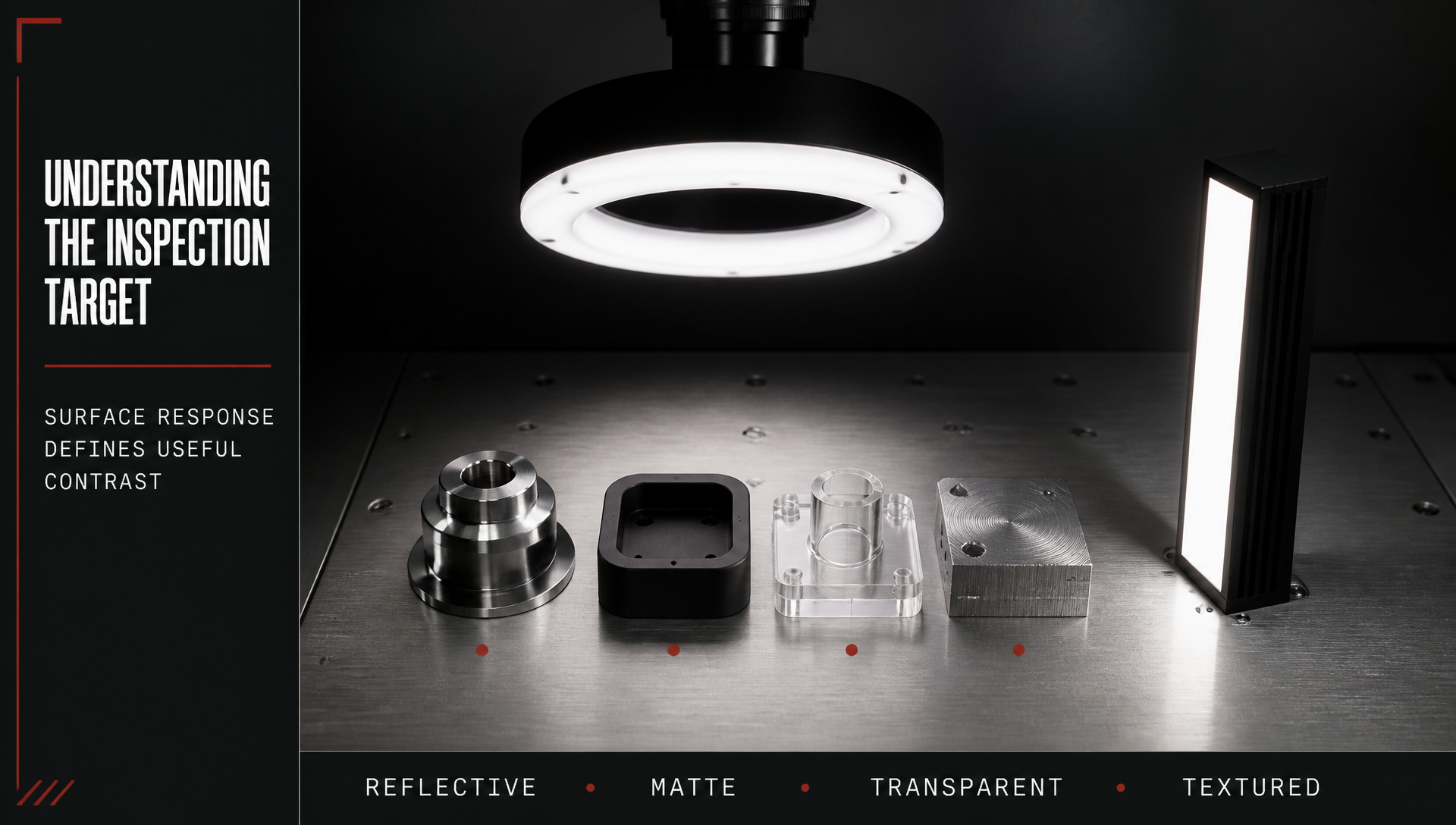
The surface of the inspection target has a major influence on lighting selection. Is the object reflective, matte, transparent, translucent, textured, or dark? Each surface can interact with light differently.
Reflective surfaces may create glare when illuminated directly.
Matte surfaces generally scatter light more evenly.
Transparent materials can produce unwanted reflections or allow light to pass through the object.
Dark surfaces may require stronger or more focused illumination to reveal small features.
Textured surfaces can benefit from directional lighting that emphasizes changes in surface geometry.
Understanding these characteristics helps engineers determine which machine vision light can produce the strongest and most useful image contrast.
Defect and Feature Characteristics
What exactly needs to be detected? A scratch, edge, printed character, missing component, surface contamination, or dimensional feature may require completely different illumination.
Small surface defects often benefit from lighting that creates strong contrast between the defect and surrounding material.
Edges may be easier to identify when the lighting direction emphasizes the boundary.
Printed characters may require uniform illumination to avoid shadows and uneven exposure.
Three-dimensional features may need directional illumination to highlight changes in height or shape.
The machine vision light should therefore be selected according to the feature being inspected rather than simply the appearance of the product.
Matching Light Type to the Application
Ring Lights
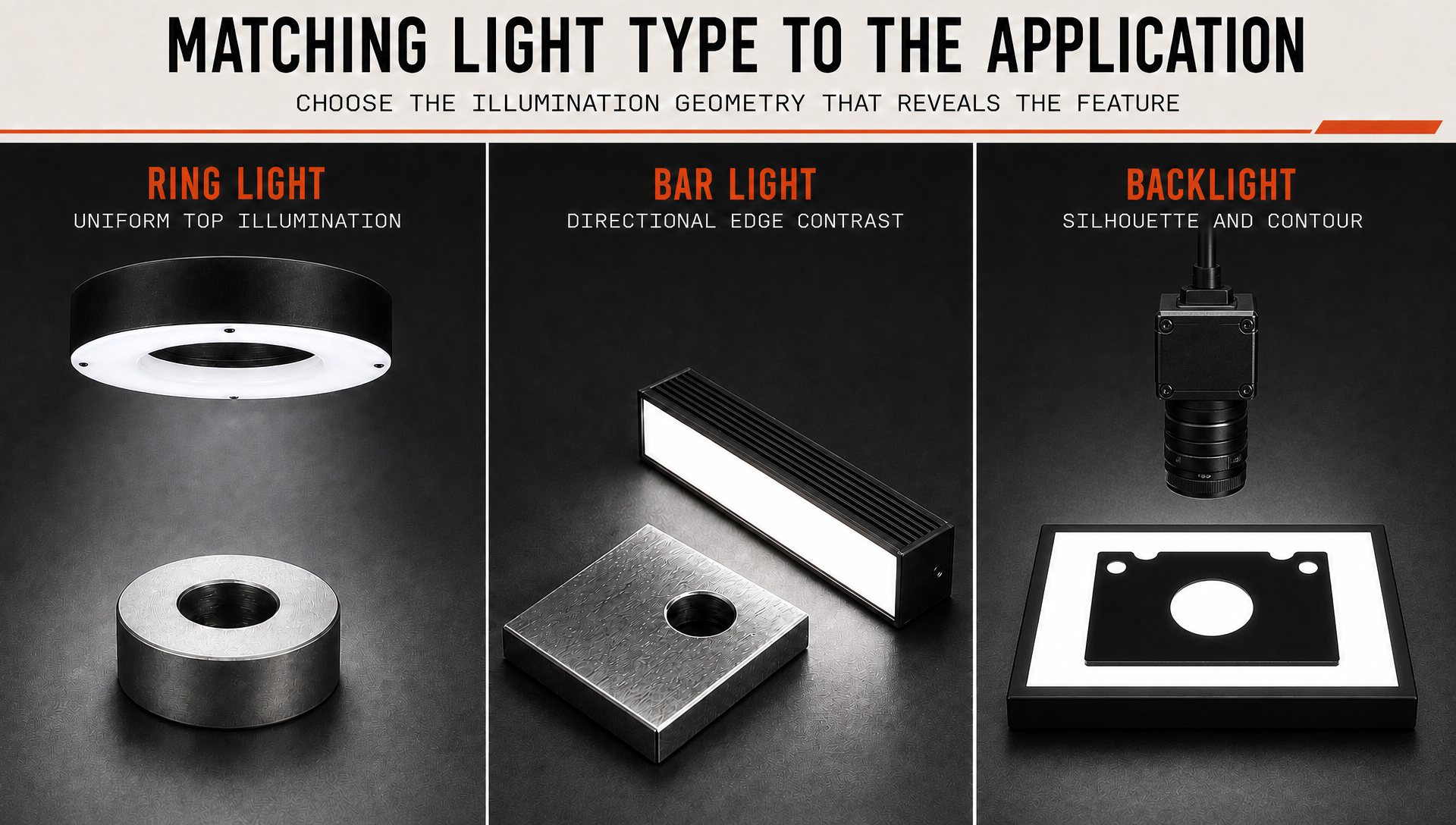
Ring lights are commonly used when the camera views the object from above or along a central axis. The surrounding illumination can provide relatively uniform lighting across many inspection targets.
A machine vision light in ring form can be useful for inspecting labels, surfaces, components, and relatively flat objects.
Different working distances may require different ring light designs.
The lighting angle can also affect whether surface details appear clearly.
For reflective objects, engineers may need to consider diffuse or low-angle configurations.
Ring lights are therefore a versatile starting point, but they should still be selected according to the object's geometry and surface characteristics.
Bar Lights
Bar lights provide more directional illumination than many ring-light configurations. They can be positioned around the inspection target according to the required lighting angle.
This makes them useful when engineers need to emphasize edges, contours, textures, or directional surface features.
Multiple bar lights can also be arranged around a product to create different illumination patterns.
The position and angle of the machine vision light can significantly influence the final image.
For large inspection areas, bar lights can provide useful flexibility in coverage and positioning.
OEM engineers should consider the available mounting space and working distance when determining whether bar lighting is appropriate.
Backlights
Backlighting is often used when the outline or silhouette of an object is more important than its surface appearance. The light is positioned behind the inspection target so that the camera sees a contrasting shape.
This method can be highly effective for dimensional inspection.
It can help reveal outer contours, holes, gaps, and edges with clear contrast.
A machine vision light designed for backlighting can also reduce the influence of surface color and texture.
For transparent or semi-transparent components, backlighting may provide particularly useful shape information.
The key is to select a light source with sufficient coverage for the entire inspection area.
Evaluating Brightness and Uniformity
Illumination Intensity
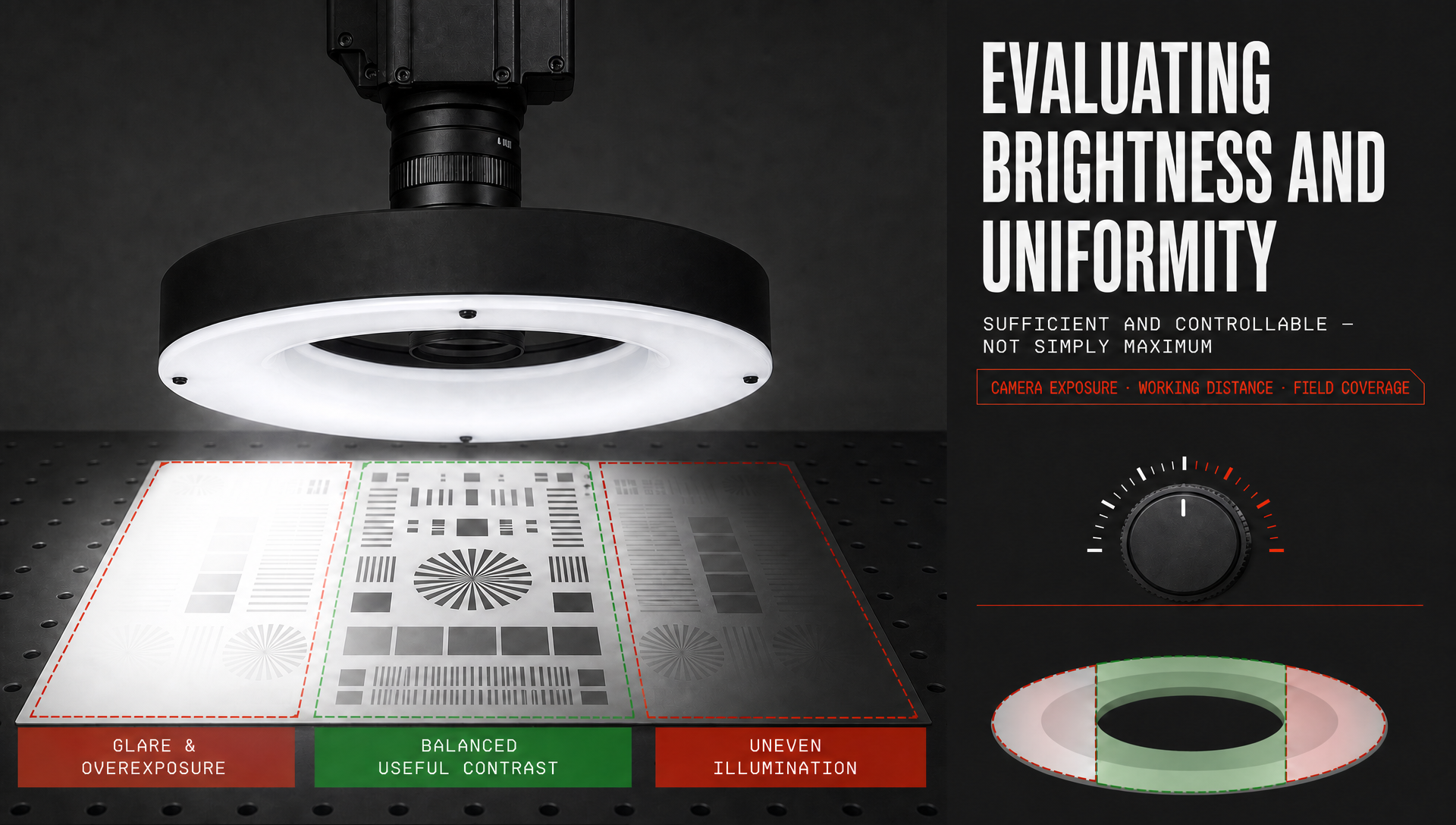
Is brighter always better? Not necessarily. Excessive illumination can create glare, overexposure, or unwanted reflections.
The required intensity depends on camera sensitivity, exposure time, lens aperture, working distance, and the material being inspected.
A machine vision light should provide enough illumination for the camera to capture the required features without creating excessive brightness.
Engineers should also consider whether brightness needs to be adjustable during system commissioning.
For applications with different product variants, adjustable lighting can provide additional flexibility.
The goal should be sufficient and controllable illumination rather than maximum output.
Lighting Uniformity
Uniformity is another important consideration. If some areas of the image are significantly brighter than others, image-processing algorithms may have difficulty establishing consistent thresholds.
Uneven illumination can make a defect appear more or less visible depending on its position.
A suitable machine vision light should therefore provide lighting that matches the required field of view.
The working distance between the light and the inspection target can also influence uniformity.
Engineers should test the complete camera, lens, and lighting combination rather than evaluating the light independently.
For demanding inspection applications, consistent illumination can be just as important as overall brightness.
Considering Working Distance and Field of View
Installation Distance
Where will the light be positioned relative to the object? The answer can influence both light intensity and coverage.
A machine vision light may perform differently at short and long working distances.
When the light is positioned too far away, illumination may become insufficient.
When it is positioned too close, the lighting pattern may become uneven or create unwanted reflections.
Mechanical clearance must also be considered when the product moves through the inspection station.
Engineers should therefore evaluate the actual installation distance rather than relying only on the nominal specifications.
Field of View Coverage
The selected light must cover the area that the camera needs to inspect. A small light may not provide sufficient illumination across a large field of view.
Conversely, using an unnecessarily large machine vision light may increase installation requirements without providing meaningful benefits.
The camera's field of view, object size, and inspection area should all be considered together.
For larger products, multiple lighting sources may be required.
The lighting arrangement should provide adequate coverage without creating excessive shadows or uneven brightness.
Testing the complete setup before finalizing the machine design can help prevent these problems.
Matching Lighting With Camera and Lens
Camera Exposure
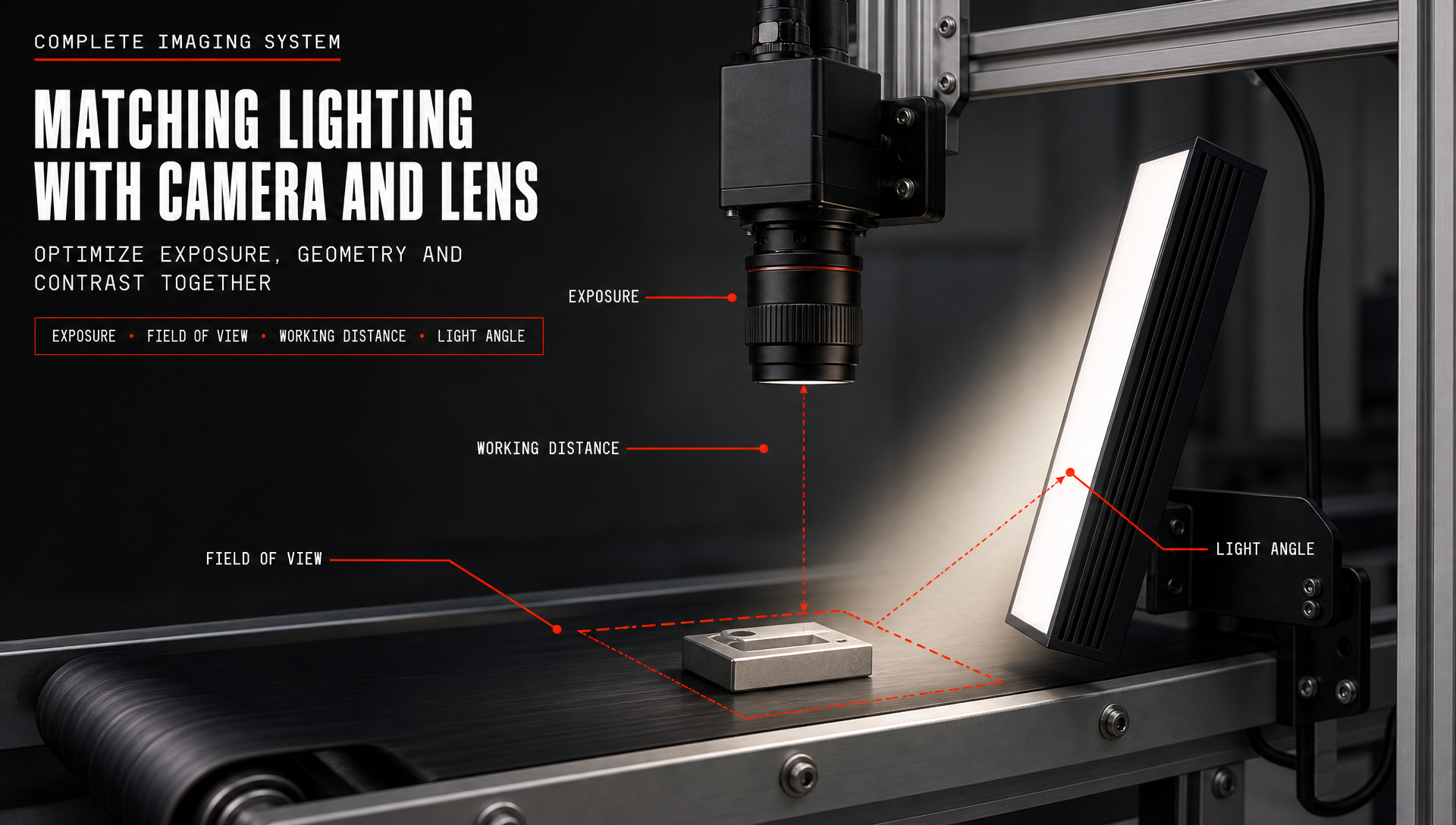
The machine vision light and camera should be considered as one imaging system. Camera exposure settings influence how much illumination is required.
A brighter light may allow shorter exposure times, which can be useful for moving objects.
Shorter exposure can help reduce motion blur during high-speed inspection.
However, excessive brightness may cause overexposure.
The machine vision light should therefore provide sufficient intensity while remaining controllable.
Engineers should optimize lighting and exposure together rather than adjusting only one component.
Lens and Optical Geometry
The lens also affects how the lighting appears in the captured image. Working distance, focal length, field of view, and aperture all influence the final imaging result.
A machine vision light that works well with one lens configuration may not produce the same result with another.
The angle between the light, lens, and inspection target can change reflections and shadows.
This is particularly important when inspecting metallic or glossy surfaces.
OEM engineers should test the actual optical configuration before selecting the final lighting arrangement.
A complete camera-lens-light evaluation is generally more effective than choosing each component independently.
Considering Control and System Integration
Brightness Adjustment
Some applications require lighting parameters to be adjusted during commissioning or production. In these cases, controllable illumination can be valuable.
A machine vision light with adjustable brightness allows engineers to optimize contrast without physically replacing the light source.
This can also help accommodate different products or inspection conditions.
For automated equipment, brightness control can be integrated with a dedicated controller.
A suitable control solution can make lighting adjustment easier during machine setup.
Engineers should therefore consider both the light itself and how it will be controlled.
For applications that require higher output or more precise control, a dedicated high-power lighting control solution can be evaluated alongside the selected light.
Triggered Illumination
Triggered lighting can be useful when objects move through an automated inspection station. Instead of keeping the light continuously active, illumination can be synchronized with image acquisition.
This can help create consistent imaging conditions.
It may also reduce unnecessary lighting duration during high-speed operation.
A machine vision light used with triggering should be evaluated together with the camera and automation controller.
Trigger timing needs to match the inspection sequence.
For OEM equipment, this coordination can help create a more repeatable imaging process.
Evaluating Environmental and Mechanical Requirements
Industrial Operating Conditions
Where will the inspection system operate? Factory environments may involve dust, vibration, temperature changes, or continuous operation.
The machine vision light should be suitable for the actual operating conditions of the equipment.
Engineers should consider housing construction, heat dissipation, cable routing, mounting method, and expected operating time.
High-output lighting can generate additional heat, making thermal management important.
The light should also be positioned so that it does not interfere with moving machine components.
Considering these conditions during the design stage can help improve long-term system stability.
Maintenance and Replacement
Lighting components may eventually require replacement or adjustment. OEM engineers should therefore consider how easily the machine vision light can be accessed.
A difficult-to-reach light can increase maintenance time.
Cable connections should be positioned where technicians can access them safely.
Mounting should also allow the light to be aligned consistently after maintenance.
If the machine is produced in batches, standardized lighting configurations can simplify replacement.
Good accessibility can reduce downtime and make routine maintenance more manageable.
Selecting a Machine Vision Light for OEM Equipment
Balancing Performance and Cost
The most expensive machine vision light is not automatically the best choice. OEMs should focus on whether the selected light provides the required image quality and integration performance.
A simple inspection may not require a high-output lighting system.
A demanding application may justify stronger illumination or more sophisticated control.
The cost of installation, control equipment, maintenance, and replacement should also be considered.
Engineers should evaluate the complete lighting solution rather than comparing only the purchase price.
The right balance is a lighting configuration that delivers stable inspection results without unnecessary specifications.
Testing Before Final Selection
Why test the lighting before finalizing the design? Because specifications alone cannot predict every imaging result.
Different materials can react differently to the same illumination.
Small changes in light angle can significantly affect reflections and contrast.
The camera and lens can also change the apparent performance of a machine vision light.
Prototype testing allows engineers to evaluate actual image quality under realistic conditions.
This process can reveal problems with glare, shadows, insufficient brightness, or uneven illumination before mass production.
For OEM projects, early lighting tests can therefore reduce redesign and commissioning risks.
HIFLY Lighting Solutions for Machine Vision Applications
Matching Lighting With System Requirements
Selecting a machine vision light is ultimately an imaging decision rather than simply a product selection decision. The inspection target, camera, lens, working distance, field of view, brightness, and control method all need to work together.
HIFLY provides machine vision lighting and related vision components for industrial inspection applications, giving OEMs and system integrators options for different imaging requirements.
A broader lighting portfolio can make it easier to compare different illumination structures before finalizing the machine architecture.
For applications using several independently controlled lights, a multi-channel lighting control option can also be considered to coordinate illumination within the inspection system.
The objective should always be to create a stable image that clearly reveals the feature being inspected.
When lighting is selected according to the complete application rather than a single specification, OEM engineers can achieve a more consistent and maintainable vision system.
FAQ
What is the most important factor when selecting a machine vision light?
The inspection target is usually the best starting point. Surface characteristics, defect type, camera, lens, working distance, and required contrast should all be considered.
Is a brighter machine vision light always better?
No. Excessive brightness can cause glare and overexposure. The ideal intensity is enough to produce a clear and consistent image.
Should lighting be tested with the camera?
Yes. The actual camera, lens, object, and lighting arrangement should be tested together because optical conditions can significantly affect image quality.
When is a high-power light useful?
High-power lighting can be useful when the inspection target requires stronger illumination, the working distance is relatively large, or the application involves demanding imaging conditions.