EN


Desiccant Packet Inspection and Robot Positioning with Machine Vision Backlighting
Flexible desiccant packets create several inspection challenges on an automated line. The system may need to confirm that filling material is present, identify an empty or damaged pouch, detect possible material leakage, calculate each packet’s position and angle, and send coordinates to a robot. A planar machine vision backlight is well suited to this task because it converts translucent film packages into high-contrast silhouettes. Instead of relying on printed graphics or unstable surface reflections, the camera can analyze the packet outline, sealed perimeter, and internal filled region. The supplied application images also show that useful contour features remain visible when packets rotate or overlap slightly.
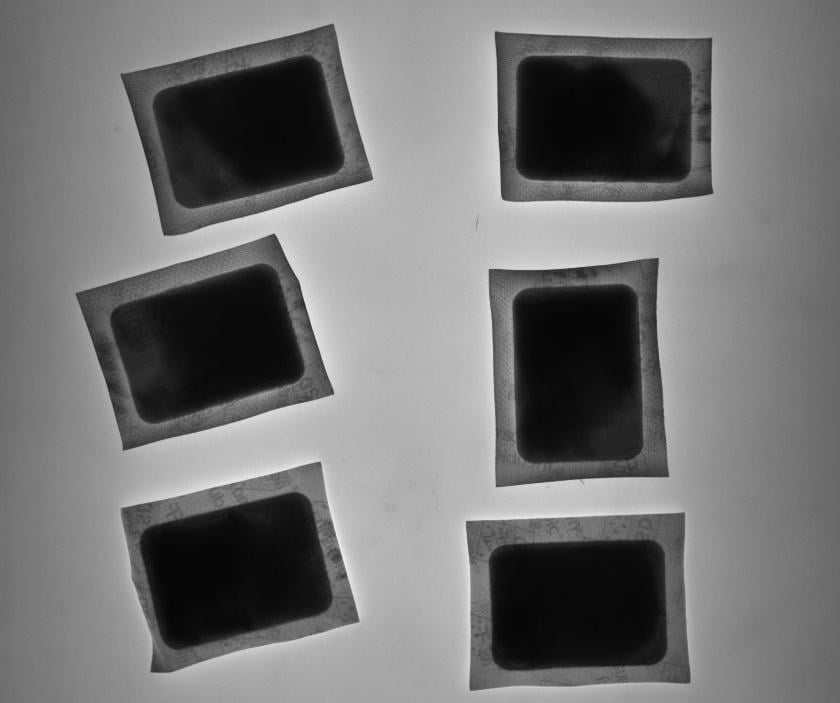
With front lighting, thin packaging film can produce glare, wrinkles, shadows, and changes caused by printing. These effects may hide the actual boundary of the pouch or make the internal desiccant look inconsistent. A packet that is tilted, curved, or slightly folded can reflect light differently even when it is acceptable. That variability makes fixed grayscale thresholds difficult to maintain. It also complicates robot localization because the outer edge may merge with the conveyor, tray, or surrounding packets.
A planar backlight places a broad, uniform luminous surface behind the packets. Light passes around and partly through the film, while the filled area blocks more light and appears darker. The image is therefore simplified into a bright background, a visible sealed border, and a dark internal region. This transmitted-light geometry suppresses most surface texture and printing. It gives the vision algorithm a more stable basis for segmentation than reflected-light brightness alone.
The first task is fill-presence inspection. A normal filled packet contains a substantial dark central area, while an empty or underfilled pouch should produce a different internal-area pattern. The algorithm can measure the size, position, density, and continuity of the filled region. However, the final threshold must be created from representative good, empty, and partially filled samples; the source presentation does not provide production limits or detection accuracy.
The second task is package-integrity inspection. The system can compare the outer seal contour with an approved reference and search for missing edges, irregular bulges, tears, or material extending beyond the expected pouch boundary. Backlighting is particularly useful for contour-based checks, but it cannot prove that every microscopic puncture or weak seal will be visible. The actual defect-size requirement must be confirmed with physical samples.
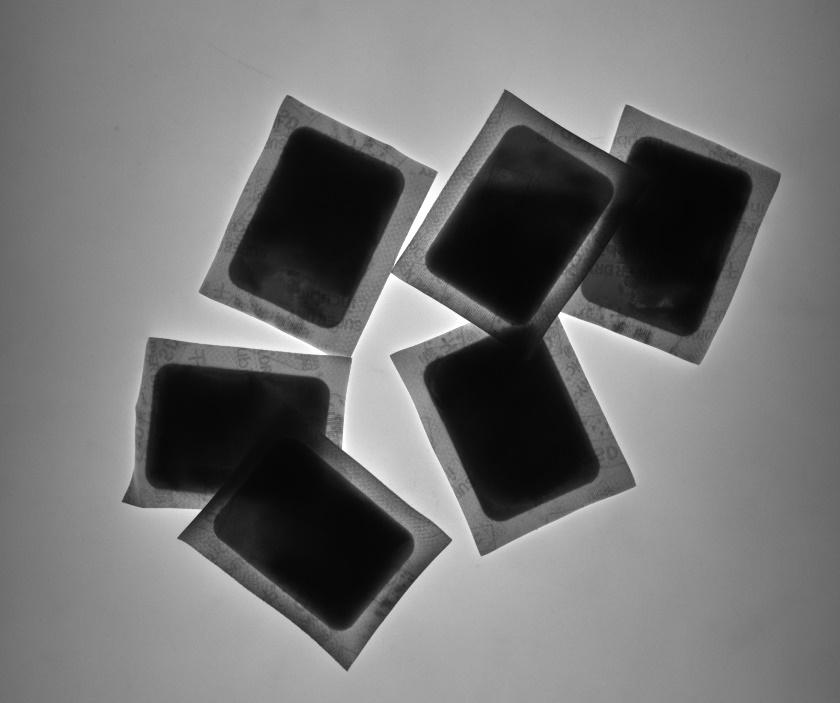
The third task is localization. After segmentation, the algorithm can calculate packet center coordinates, rotation angle, bounding contour, and confidence. The supplied test images include separated packets, multiple orientations, and slight overlap. These images indicate that valid features remain visible under those conditions, supporting robot pick-and-place guidance. For ambiguous or severe overlaps, the system should output a reject or no-pick status instead of sending an unsafe grasp point.
Overlap handling deserves a separate decision rule. Two packets that only touch at their sealed edges may still be separated through contour concavities or distance-transform peaks. When one filled region covers another, however, the hidden packet may not provide enough geometry for reliable center and angle estimation. The software should therefore report object count, overlap score, visible-contour ratio, and grasp clearance. The robot should pick only when the selected pouch has a verified free edge and sufficient clearance from adjacent packets. This conservative logic prevents a visually plausible coordinate from becoming a double pickup or a torn package.
A practical workflow starts with background normalization and packet segmentation. Morphological filtering can remove isolated noise while preserving the sealed perimeter. Connected-component analysis then separates candidate packets. For each valid object, the software measures contour area, rectangularity, fill-region ratio, center position, and orientation. A classification stage identifies normal, empty, damaged, leaking, overlapped, or uncertain conditions. Only packets that meet both quality and localization requirements should receive a robot pick command.
The vision-to-robot interface should transmit coordinates in a calibrated robot frame, not raw image pixels. Calibration must account for camera position, lens distortion, backlight plane, robot reach, gripper size, and changes in part height. Reference images and calibration records should be saved for maintenance. If the camera, lens, machine vision light, mounting height, or fixture changes, the system should be revalidated before production resumes.
Production Validation and Engineering Limits
Before deployment, test normal packets, empty packets, partial filling, damaged edges, leaking granules, different film lots, printed variations, wrinkles, full rotation range, slight overlap, severe overlap, and contamination on the backlight surface. Repeat the test after the light reaches thermal stability and under expected ambient-light conditions. Record image exposure, gain, aperture, working distance, field of view, backlight output, packet-to-light distance, robot calibration, and all decision thresholds.
The source material demonstrates clear contour visibility but does not provide accuracy, cycle time, minimum defect size, or robot-repeatability data. These values must be measured on the intended production line. For a new project, send HIFLY representative good and defective packets, overlap conditions, line speed, field of view, robot interface, available space, and acceptance criteria. A controlled application test can then define a reproducible camera, lens, backlight, controller, and mechanical setup.
Send your packet samples and robot-guidance requirements to HIFLY for a controlled backlighting test and configuration recommendation.