EN
EN


For OEMs developing automated inspection equipment, lighting control is more than a supporting function. It directly affects image consistency, defect visibility, inspection accuracy, and overall system stability. A properly selected machine vision light controller allows the lighting system to work together with cameras, sensors, triggers, and inspection software instead of functioning as an isolated component.
Why does this matter to an OEM? An inspection machine may need to handle different products, production speeds, camera configurations, and lighting conditions. The machine vision light controller therefore needs to provide enough flexibility for the complete system rather than simply offering basic brightness adjustment.
HIFLY provides machine vision lighting and controller solutions for industrial automation applications. Its controller portfolio covers standard digital, standard analog, mini digital, high-power, and other configurations, allowing OEM engineers to select a machine vision light controller according to channel requirements, output power, control method, and installation space.
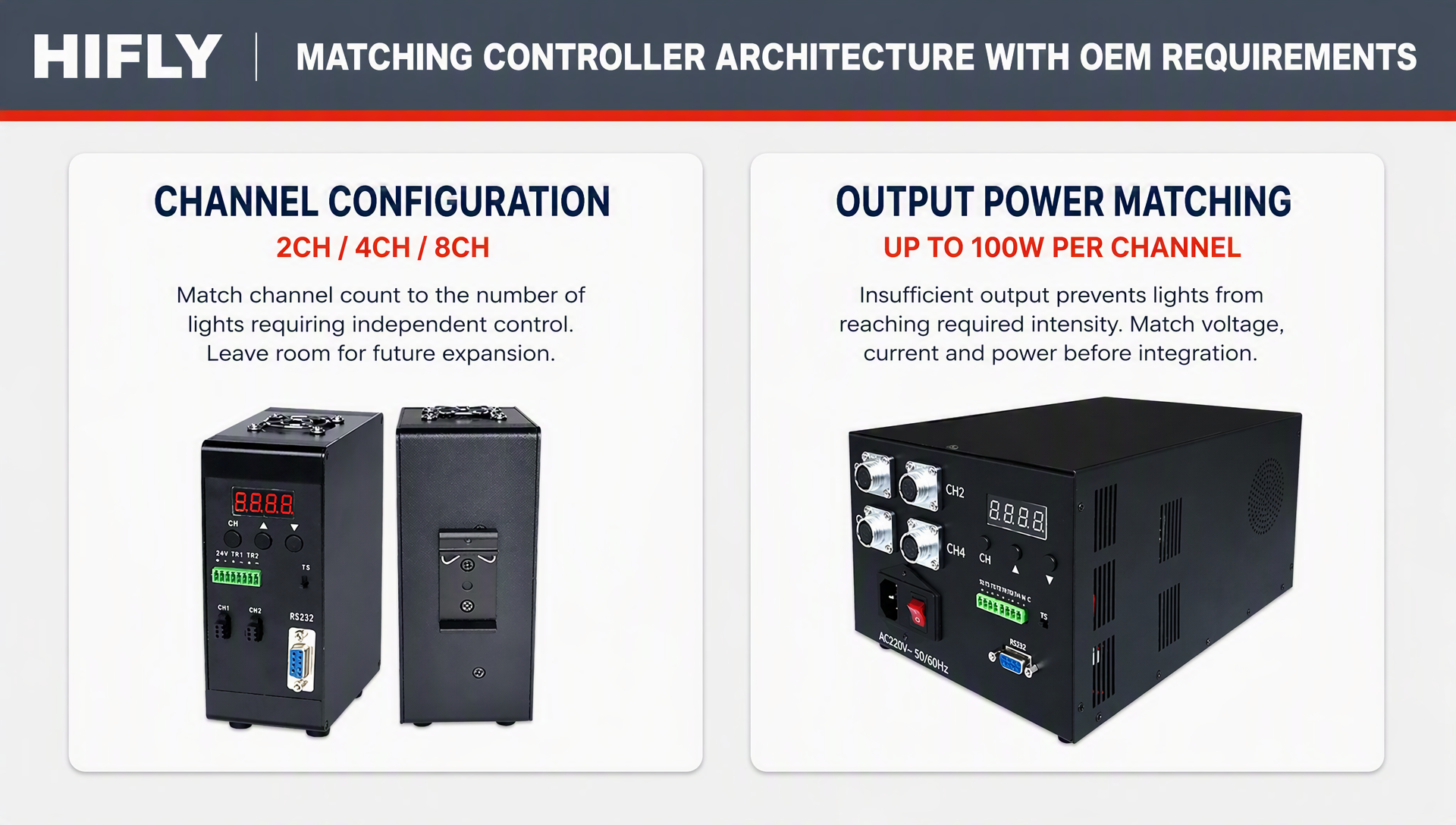
Matching Controller Architecture With OEM Requirements
Channel Configuration and System Expansion
How many lighting devices will the machine use? This should be one of the first questions an OEM engineer considers when selecting a machine vision light controller. A simple inspection station may only require one lighting source, while a more complex system may combine ring lights, backlights, bar lights, or several illumination zones.
A multi-channel machine vision light controller can simplify the system architecture when several lights need independent control. Different channels can be configured for different illumination requirements, allowing an inspection machine to switch between lighting conditions without installing multiple independent controllers.
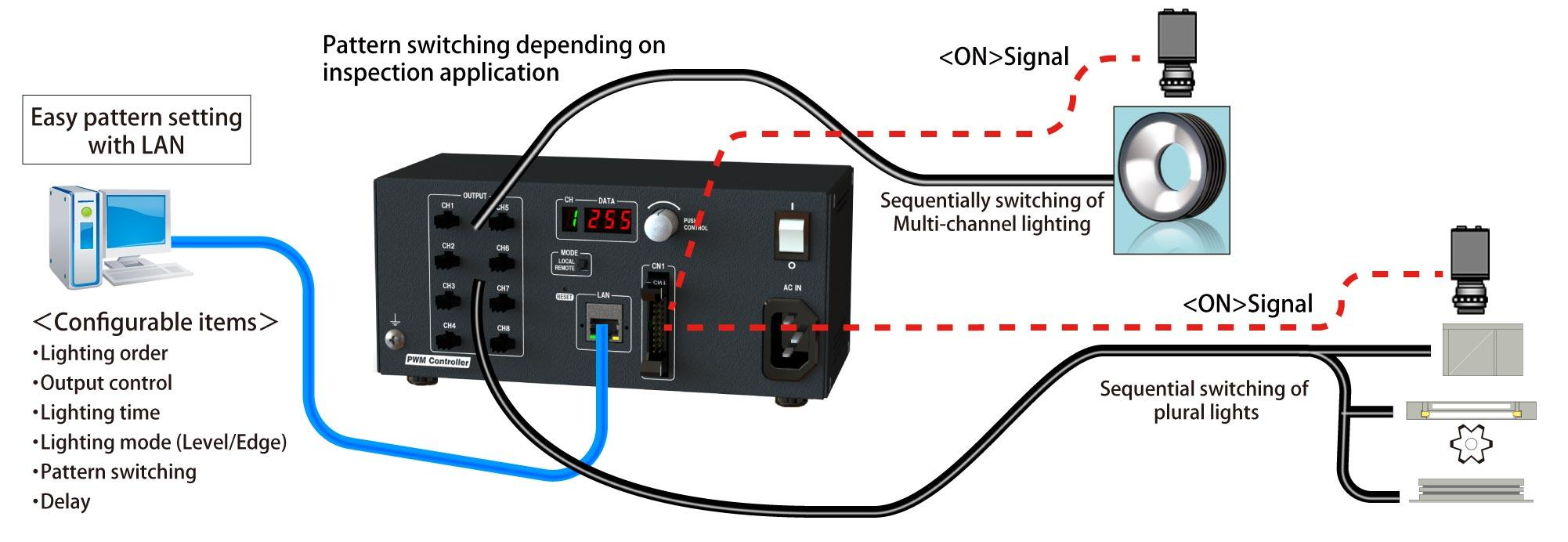
For OEM equipment, channel planning should also consider potential system expansion. Would the customer need an additional light after upgrading the machine? Choosing a machine vision light controller with suitable channel capacity can reduce redesign work and make future modifications easier.
HIFLY offers controller configurations with different channel capacities, including 2-channel, 4-channel, and 8-channel options. This gives OEM developers more flexibility when designing inspection equipment with different lighting architectures.
Output Power and Lighting Compatibility
Power matching is another essential consideration. What happens if the selected machine vision light controller cannot provide sufficient output power? The connected light may not reach the required intensity, which can affect image quality and inspection performance.
OEM engineers should compare the controller's rated output with the actual requirements of the connected machine vision light. A standard controller may be suitable for conventional illumination, while a high-power machine vision light controller may be more appropriate for demanding lighting applications.
HIFLY's DCS-2C100W-24PS is a digital high-power controller with two channels and 100W output power per channel. It supports 255-level brightness adjustment and high- and low-level trigger switching, making it suitable for applications requiring stronger lighting output.
Selecting a machine vision light controller according to voltage, current, channel count, and power requirements helps OEMs avoid compatibility problems during system integration.
Control Performance for Consistent Image Acquisition
Brightness Adjustment and Repeatability
Is maximum brightness really the most important specification? Not necessarily. In machine vision, consistent illumination is often more important than simply producing a brighter image.
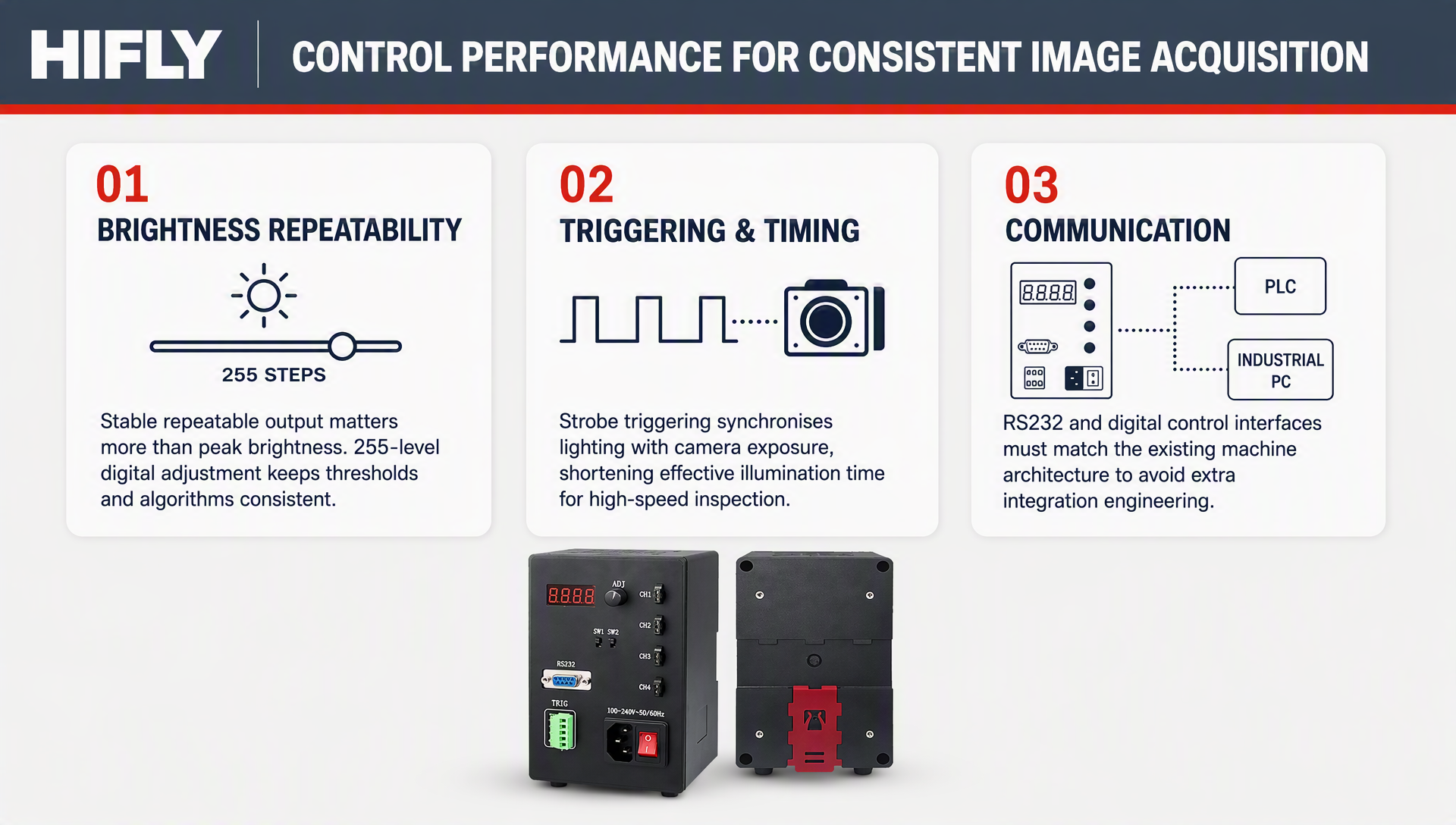
A machine vision light controller should allow engineers to establish repeatable illumination conditions. If brightness changes between inspection cycles, the camera may receive inconsistent image information, making threshold settings and image-processing algorithms less stable.
Digital brightness adjustment is particularly useful for OEM equipment because different products may require different illumination levels. HIFLY's digital controller range includes models designed for adjustable machine vision lighting, giving engineers more control during system commissioning.
A properly selected machine vision light controller therefore becomes part of the image-quality strategy. Stable output helps cameras capture repeatable images, while adjustable illumination provides greater flexibility when inspection parameters need to be optimized.
Triggering and Timing Control
What happens when a production line moves too quickly for continuous illumination? In many automated inspection systems, triggered lighting is the practical solution.
A machine vision light controller with trigger capability can synchronize illumination with camera exposure or machine events. This can help reduce unnecessary lighting duration and improve the consistency of images captured from moving objects.
Triggering becomes especially important for high-speed inspection. Instead of keeping the light continuously active, the machine vision light controller can activate the required illumination according to the inspection sequence.
OEM engineers should therefore examine not only whether a controller supports triggering, but also how the trigger signal integrates with the complete machine architecture. HIFLY provides controller models with trigger functions across different product categories, giving system designers more options for different automation configurations.
Communication and Machine Integration
Can the machine vision light controller communicate effectively with the rest of the machine? This becomes increasingly important when an OEM is developing a complete automated inspection platform.
Communication methods influence how easily the controller can be integrated with PLCs, industrial computers, cameras, or other control systems. Depending on the model, HIFLY controllers provide different control configurations, including digital and analog options.
For an OEM, communication should be evaluated together with the machine's existing architecture. A technically capable machine vision light controller may still create unnecessary engineering work if its interface does not match the control structure of the equipment.
The controller should therefore be evaluated as part of the complete vision system rather than as an independent electrical component.
Mechanical Integration and Industrial Stability
Installation Space and Thermal Management
Where will the controller be installed? Space constraints can become a practical challenge when OEM equipment has a compact electrical cabinet or limited internal mounting area.
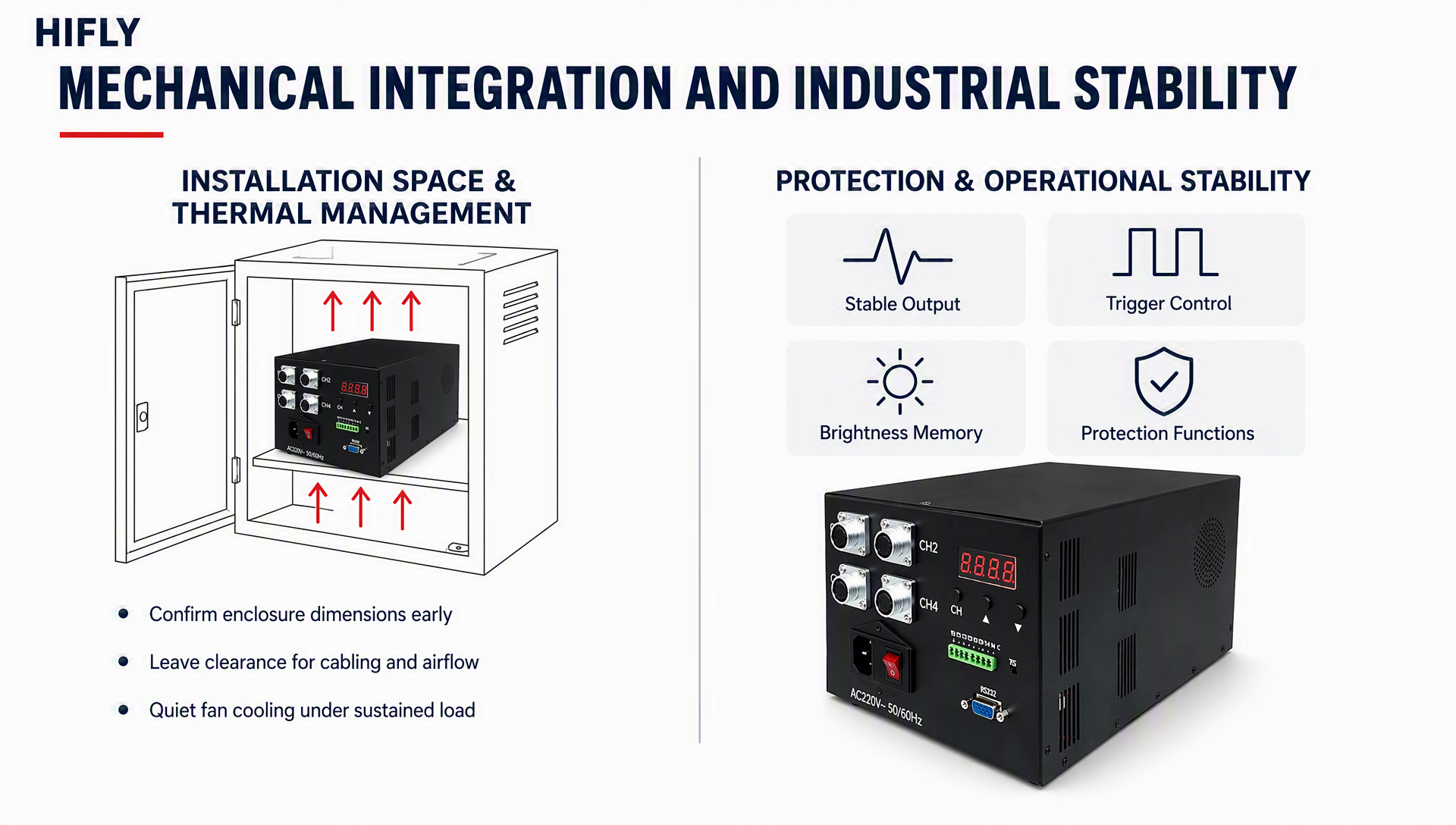
The physical dimensions of a machine vision light controller should therefore be considered before finalizing the machine enclosure. Engineers should also leave sufficient space for cable connections, ventilation, maintenance, and heat dissipation.
Thermal management becomes particularly important for high-power applications. A high-power machine vision light controller may generate more heat when operating under demanding loads, making suitable heat dissipation an important part of system design.
HIFLY's high-power controller range includes multiple output configurations, allowing OEMs to select a model according to the actual lighting load rather than choosing excessive capacity without a clear application requirement.
Good mechanical planning can prevent problems that only appear after a prototype is assembled. Checking dimensions, wiring access, mounting position, and thermal conditions early can make the final machine easier to manufacture and maintain.
Protection and Operational Stability
What if a lighting source is connected incorrectly or the operating environment changes? Protection and stability functions can become valuable in these situations.
A machine vision light controller designed for industrial applications should provide stable output and appropriate protection features. HIFLY's controller products include functions such as stable output, trigger control, brightness memory, and protection features depending on the model.
For example, the DCS-2C100W-24PS provides stable output, a silent fan for heat dissipation, and automatic brightness memory after adjustment. These features can be useful for OEM equipment that operates continuously or requires repeatable lighting parameters.
These functions are particularly relevant when a machine is expected to run for extended periods. Stable illumination reduces variations that could affect image acquisition, while parameter memory can simplify operation after power interruptions.
When evaluating a machine vision light controller, OEMs should therefore look beyond basic brightness control. Protection, stability, memory, and operating conditions can all influence the long-term usability of the completed machine.
Selecting the Right Controller Type for OEM Projects
Standard Digital Controllers
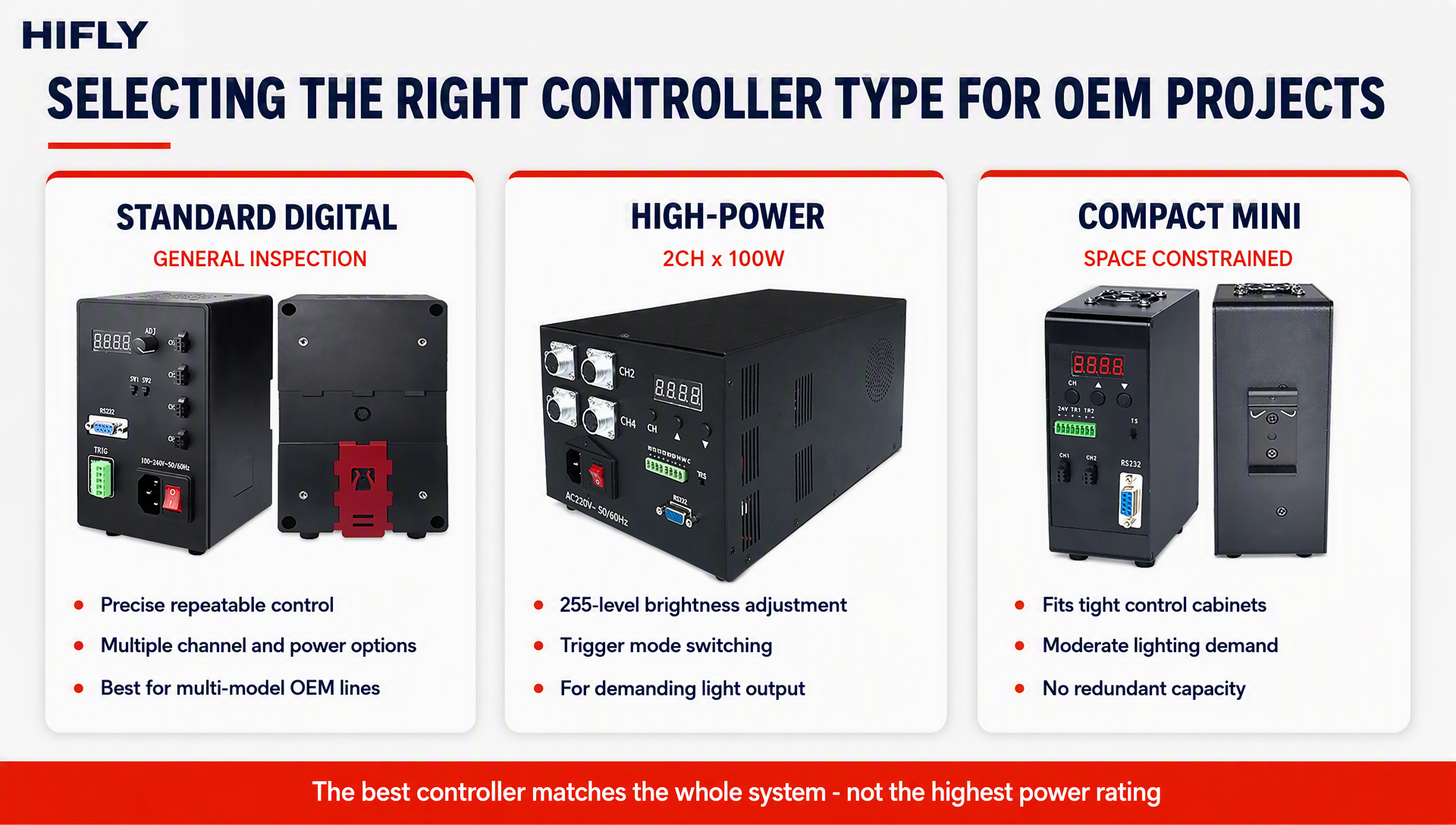
A standard digital machine vision light controller can be a practical option for general industrial inspection systems. Digital control provides engineers with more precise parameter adjustment, which can be useful when lighting conditions need to be reproduced consistently.
HIFLY's standard digital range includes different channel and power configurations. The product category includes models such as the DCS-2C003W-5PS, DCS2.0-8C015W-24PS, DCS2.0-4C015W-24PS, and DCS3-4C080W series.
For equipment manufacturers, this variety reduces the need to force one controller into every application. Instead, the machine vision light controller can be selected according to the actual number of lights, output requirements, and control method.
This approach is particularly useful for OEMs producing several machine models with different inspection configurations. A suitable controller can provide the required functions without unnecessarily increasing system complexity.
High-Power Controllers
Some inspection applications require substantially higher lighting output. In these cases, a high-power machine vision light controller can provide greater flexibility than a conventional controller.
HIFLY's high-power range includes models with different output capacities. The DCS-2C100W-24PS, for example, provides two channels with 100W output per channel and supports trigger switching and 255-level brightness adjustment.
A high-power machine vision light controller can be considered when the lighting source requires stronger output, when several demanding lights are connected, or when the application requires high illumination intensity.
However, higher power does not automatically mean better performance. OEMs should still match the controller to the light source, electrical requirements, machine cycle, thermal environment, and inspection objective.
Compact and Application-Specific Controllers
Does every OEM machine need a large controller? No. Compact inspection equipment may benefit from a smaller machine vision light controller that fits more easily into restricted installation spaces.
Mini digital controllers can be useful where cabinet space is limited while the lighting requirements remain moderate. HIFLY includes mini digital controllers within its controller product portfolio, giving OEMs another option when installation space is an important design constraint.
The best machine vision light controller is therefore not necessarily the most powerful model. It is the model that fits the complete system requirements without unnecessary capacity, complexity, or installation burden.
OEM Selection Checklist
Electrical and Lighting Parameters
Before purchasing a machine vision light controller, OEM engineers should confirm the lighting source's voltage, current, rated power, and required brightness range.
The controller's channel count should match the number of independently controlled lights.
The output power should provide sufficient operating capacity without creating an unsuitable electrical configuration.
The selected machine vision light controller should also be compatible with the specific lighting technology used in the inspection system.
These checks can significantly reduce compatibility problems during prototype development.
Control and Integration Requirements
OEM teams should also confirm whether the machine vision light controller supports the required trigger method and communication interface.
Can it communicate with the PLC or industrial computer?
Can the brightness parameters be adjusted precisely?
Can the settings be retained after a power interruption?
Does the controller fit the available cabinet space?
These practical questions are often more important than comparing a single specification in isolation. HIFLY's controller portfolio includes standard digital, standard analog, mini digital, high-power, and common controller categories, giving OEMs multiple configurations for different industrial applications.
HIFLY Machine Vision Light Controller Solutions for OEMs
For OEMs, choosing a controller supplier is also about reducing engineering complexity. HIFLY provides industrial cameras, industrial lenses, machine vision lights, controllers, and related machine vision products as part of its broader product portfolio. This allows OEM engineers to evaluate lighting control together with the rest of the imaging system.
OEM engineers can explore HIFLY's complete machine vision controller product range when comparing standard digital, analog, mini digital, and high-power solutions.
For applications requiring higher output, the DCS-2C100W-24PS high-power controller provides two channels with 100W output per channel, brightness adjustment, trigger switching, and front-panel operation.
For multi-channel applications, the DCS3-4C080W series controller provides four-channel control and adjustable lighting functions for machine vision applications.
The right machine vision light controller should ultimately be selected according to the complete inspection system. By evaluating power, channels, triggering, communication, mechanical dimensions, thermal management, and application requirements together, OEMs can build more stable and easier-to-integrate vision equipment.
For OEM projects that require customized lighting and control configurations, working directly with an experienced machine vision supplier can also simplify technical communication, product matching, and system integration.
FAQ
What is a machine vision light controller used for?
A machine vision light controller manages the illumination used by a machine vision system.
It can control parameters such as brightness, triggering, and lighting duration depending on the controller design.
The controller helps maintain consistent lighting conditions during image acquisition.
Stable illumination can improve the repeatability of images captured by industrial cameras.
It can also allow OEM engineers to adjust lighting according to different inspection requirements.
Different controller models support different channel, power, and communication configurations.
The correct machine vision light controller should therefore be selected according to the complete lighting and inspection system.
How many channels should an OEM machine vision light controller have?
The required channel count depends on the number of lighting sources that need independent control.
A simple inspection system may only require one or two channels.
A more complex system may use several lights and therefore require four or more channels.
OEMs should also consider possible machine expansion when selecting a machine vision light controller.
Choosing an appropriate channel configuration can simplify wiring and system architecture.
HIFLY provides controller models with different channel configurations for different industrial applications.
What specifications should be checked before selecting a controller?
OEM engineers should check output voltage, output power, channel count, trigger capability, communication interface, dimensions, and installation requirements.
The controller should be electrically compatible with the selected machine vision light.
Its power capacity should also match the actual lighting load.
The machine vision light controller should support the required trigger and communication method.
Mechanical dimensions and heat dissipation should be considered during cabinet design.
These specifications should be evaluated together rather than individually.
Can a machine vision light controller be integrated into an existing OEM system?
Yes, provided that the controller's electrical, control, and communication requirements match the existing system.
OEM engineers should confirm the power supply and lighting compatibility first.
They should then check trigger signals and communication interfaces.
Mechanical dimensions and wiring access should also be considered.
For systems using software-based control, communication compatibility can be particularly important.
A suitable machine vision light controller can then be integrated into the existing camera, PLC, lighting, and inspection workflow.