EN
EN


Machine Vision Light Pros and Cons: What OEMs Must Know
A camera can only inspect what it can see, making illumination a fundamental foundation of any automated inspection system. The right machine vision light improves contrast, reveals subtle defects, reduces image variation, and enables vision software to make reliable inspection decisions. Conversely, improper lighting causes glare, uneven shadows, and unnecessary commissioning headaches.
For OEM machine vision equipment, lighting selection demands meticulous attention because the exact same configuration must operate continuously across hundreds of standardized units. System engineers must evaluate not only raw optical quality, but also mounting space, thermal output, power requirements, control methods, and long-term batch consistency. Understanding comprehensive industrial lighting pros and cons helps OEMs make practical, data-driven decisions rather than relying on isolated component datasheets.
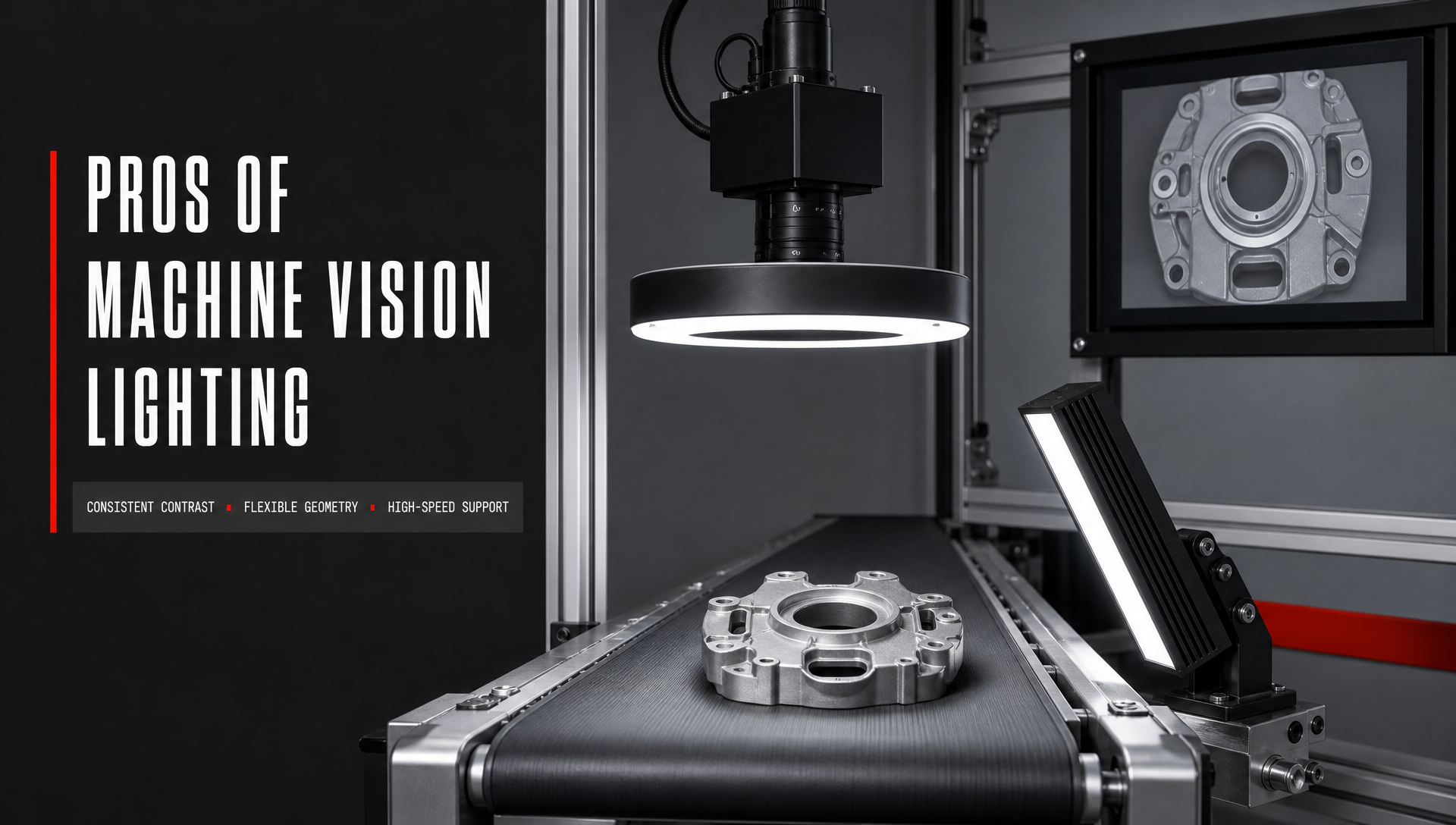
Pros of Machine Vision Lighting
Improved Image Contrast and Inspection Consistency
The primary advantage of specialized machine vision lighting is dramatically improved image contrast. Quality vision system illumination creates high visual separation between targeted features and their background, making edges crisper, surface flaws visible, and printed characters consistent across variable production runs.
Furthermore, stable automated inspection lighting maintains precise exposure conditions over millions of cycles. This eliminates the need for software algorithms to constantly compensate for fluctuating ambient light, making threshold settings easier to maintain and simplifying standardization across identical OEM machines.
Application Flexibility and High-Speed Support
Modern industrial lighting supports diverse optical geometries. Engineers can leverage ring lights for general surface evaluation, bar lights for directional glazing, backlights for crisp silhouette measurements, dome lights for reflective or curved parts, coaxial illumination for flat mirrors, or line scan lighting for continuous web processing. Having access to a broad machine vision lighting selection gives OEMs the design freedom to solve complex imaging challenges efficiently.
For high-speed production lines requiring rapid image acquisition, high-output LED illumination allows cameras to operate with extremely short exposure times. When combined with strobing and triggered controllers, these lights freeze high-speed motion without causing image blur or overheating the environment.
Cons of Machine Vision Lighting
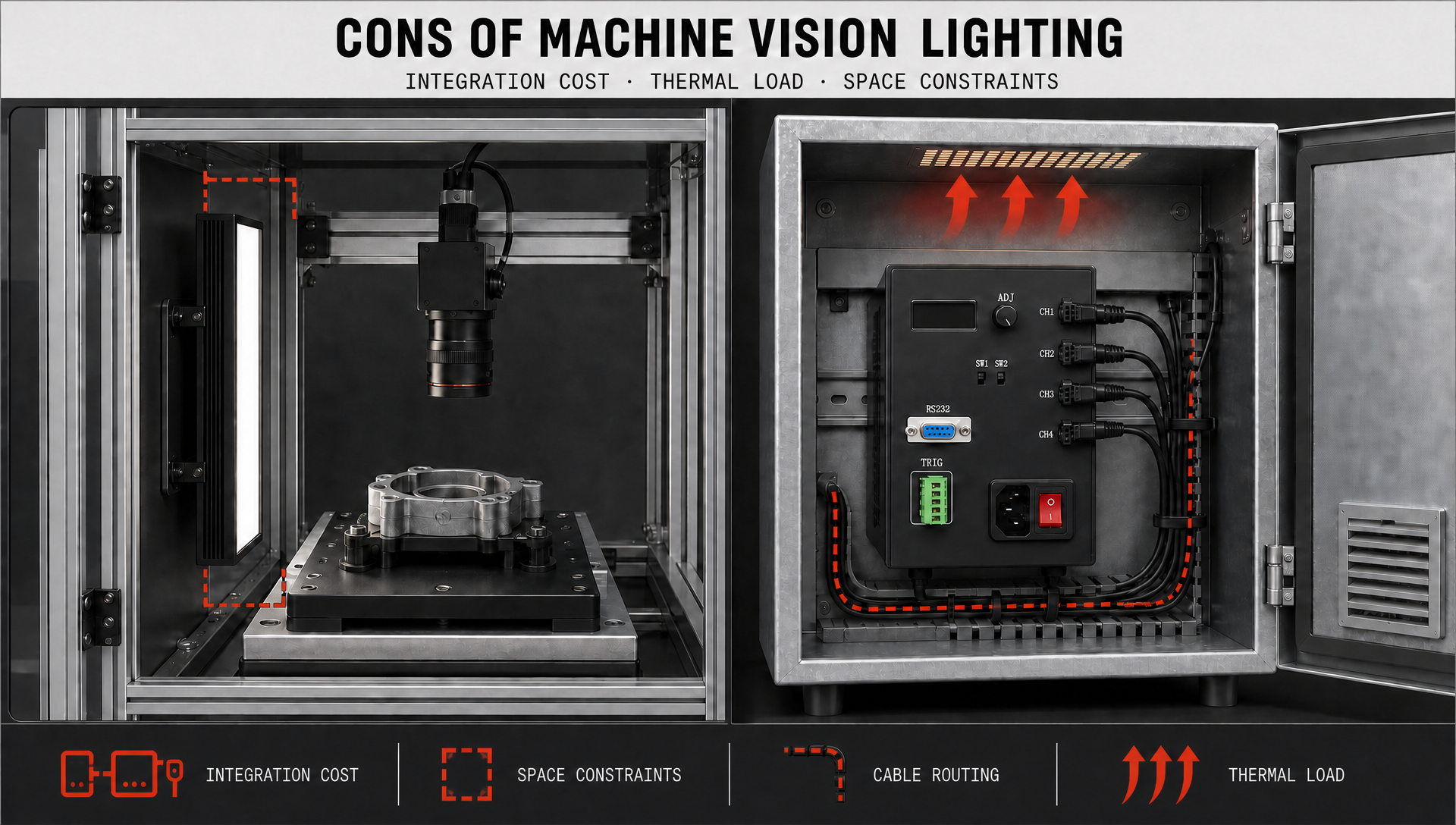
System Integration Costs and Thermal Management
Despite its clear benefits, complete machine vision lighting systems introduce noticeable upfront costs. Beyond the light units themselves, OEMs must budget for specialized controllers, power supplies, custom cabling, and precision mounting hardware. Specialized wavelengths (UV, NIR) or custom form factors further elevate initial capital expenditures.
Additionally, high-output continuous lighting generates substantial heat. Unmanaged thermal energy degrades LED lifespans, causes spectral drift, and adversely impacts nearby cameras or delicate sensors in compact enclosures. Mitigating heat requires deliberate thermal management, duty-cycle optimization, or pulsed trigger setups.
Physical Mechanical Constraints
Space limitations frequently complicate OEM machine vision setups. Compact inspection cells leave minimal clearance for bulky illumination housings. Large ring lights can collide with camera lenses or robotic grippers, while wide bar lights may not fit within narrow industrial frames. Engineers must evaluate working distances, cable exit directions, and mounting hole positions early in the CAD design phase to prevent costly retrofits.
Industrial Lighting Pros and Cons for Different Surfaces
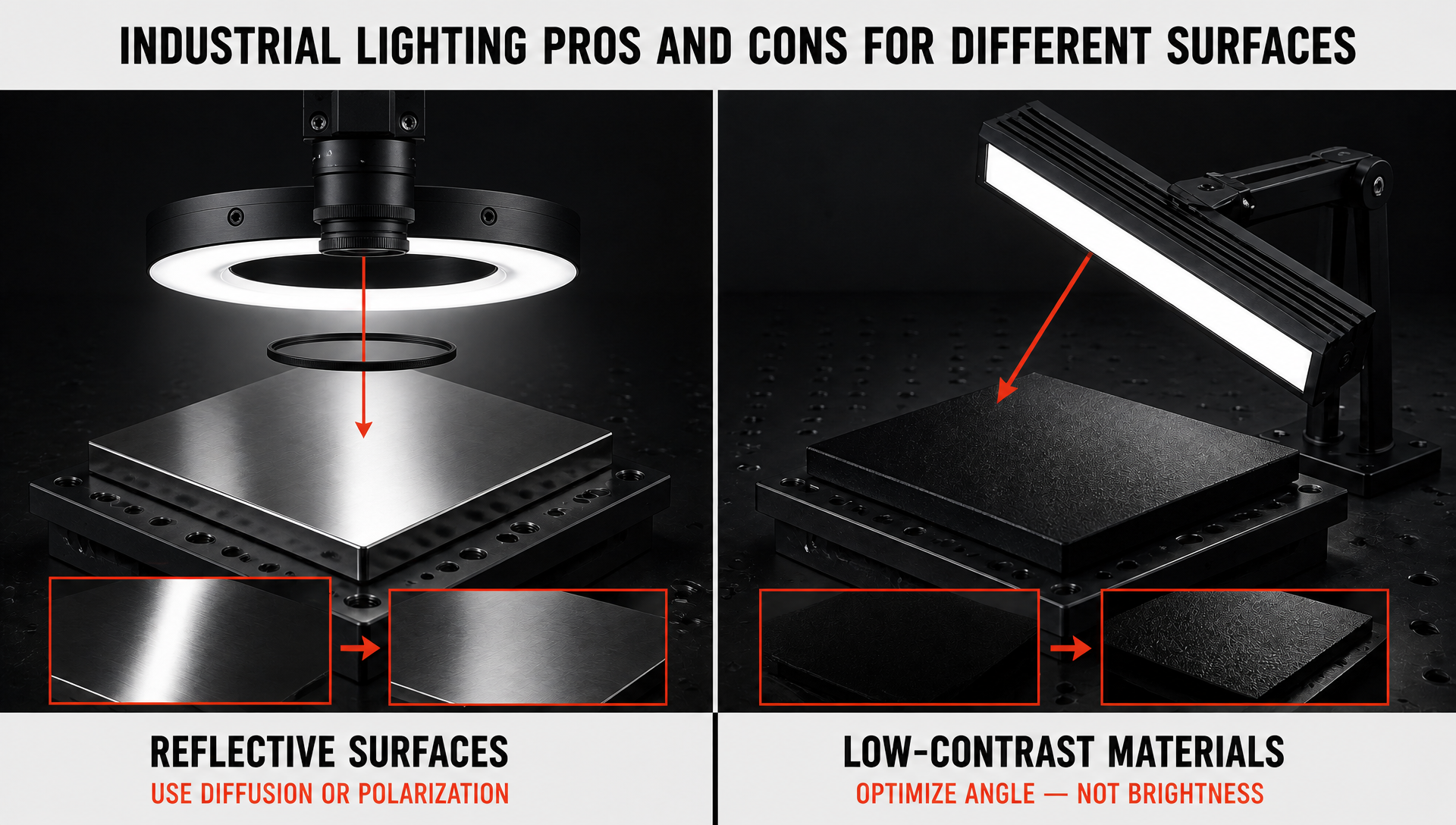
Reflective vs. Low-Contrast Target Materials
Reflective substrates like polished metal, silicon wafers, or glass packaging create severe specular reflections and hot spots. While directional illumination struggles here, diffuse dome lights or polarized filters solve the issue—though they demand rigorous testing and precise physical positioning.
Conversely, dark or highly absorbent materials require high-intensity light output. However, simply ramping up brightness is rarely enough; choosing the correct angle of incidence or optimal wavelength (such as red or infrared light) is often far more effective than sheer luminance when inspecting low-contrast items.
Critical Selection Factors for OEMs
Optical, Electrical, and Spatial Alignment
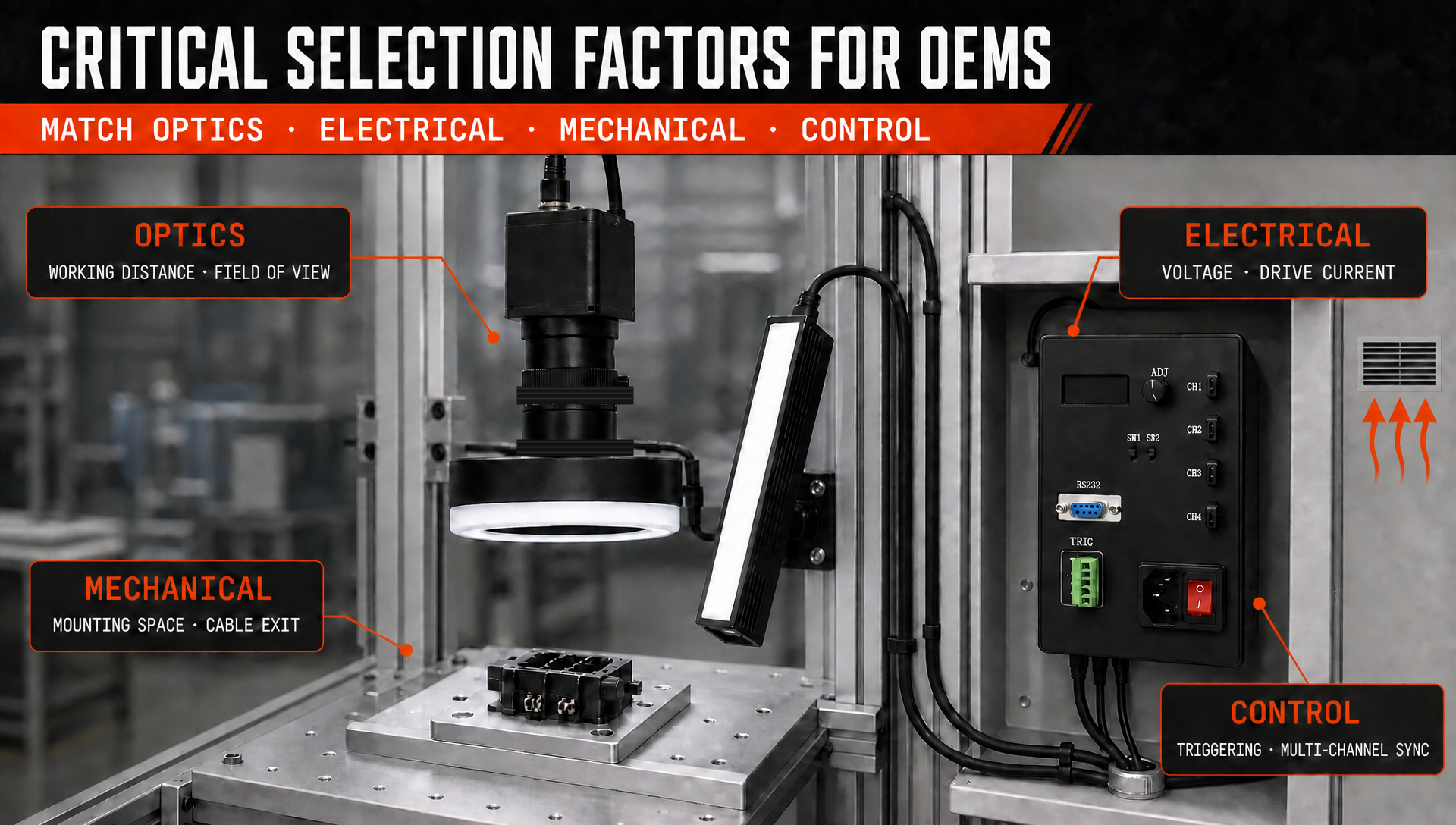
Lighting cannot be selected in isolation; it must be matched to the complete optical ecosystem. Working distance, lens field of view (FOV), target geometry, and camera sensor sensitivity dictate the required size, angle, and intensity of the light source.
Electrically, system builders must match voltage, drive current, and triggering protocols to their automation architecture. Utilizing a dedicated high-output lighting control solution ensures precise intensity modulation, sub-microsecond strobe timing, and multi-channel synchronization needed for multi-camera OEM machinery.
Optimizing Selection Strategy for OEM Projects
Standardize Proven Assemblies with Built-In Flexibility
To streamline engineering and procurement, OEMs should standardize validated lighting configurations across product lines. Reusing proven ring or bar light assemblies, standardized connectors, and uniform mounting brackets lowers development costs and simplifies field service spare-parts management.
However, standardized platforms must retain modular flexibility. Incorporating adjustable bracketry, multi-wavelength options, and programmable multi-channel controllers allows identical machine builds to adapt seamlessly to varying customer specifications. Exploring flexible machine vision lighting options allows engineers to compare different optical structures across a unified platform.
Choosing the Right OEM Lighting Partner
When selecting a commercial lighting vendor, OEMs must prioritize technical range and batch-to-batch manufacturing consistency. A single machine platform may require diverse geometries across different stations. Choosing a supplier with a comprehensive portfolio reduces vendor stack complexity.
More importantly, long-term supply stability is vital. Component changes, LED binning shifts, or mechanical revisions by the vendor can compromise calibrated inspection software across deployed machines. OEMs need suppliers that guarantee repeatable optical performance, identical mechanical tolerances, and long product lifecycles across repeat orders.
Conclusion
Proper vision system illumination delivers clear advantages: enhanced contrast, repeatable exposure, high-speed imaging support, and application versatility. These benefits must be balanced against integration costs, thermal loads, and space constraints. By systematically evaluating optics, electrical controllers, target materials, and long-term supply consistency, OEMs can build robust, highly repeatable automated inspection lighting systems that perform reliably over years of continuous operation.
FAQ
What is the main advantage of a machine vision light?
It provides predictable illumination and high image contrast, making target features distinct and easily detectable by automated vision software.
What is a common limitation of machine vision lighting?
Key trade-offs include additional system costs, heat generation in high-output modes, and physical spatial constraints in compact machinery.
How should OEMs choose lighting?
OEMs should evaluate target surface characteristics, camera/lens specs, working distance, field of view, thermal limits, and controller integration as an integrated system.
Is brighter lighting always better?
No. Overly bright illumination causes glare and sensor saturation. Optimal inspection performance relies on controlled geometry, diffusion, and precise contrast—not just raw power.