EN
EN


Does a global shutter machine vision camera eliminate motion blur better than rolling shutter types?
When capturing fast-moving objects in industrial environments, image quality depends heavily on how the sensor captures light. A global shutter machine vision camera exposes every pixel simultaneously, which is the foundation of its advantage over rolling shutter alternatives. This fundamental difference determines whether your imaging system delivers sharp, reliable data or suffers from distortion that compromises downstream processing.
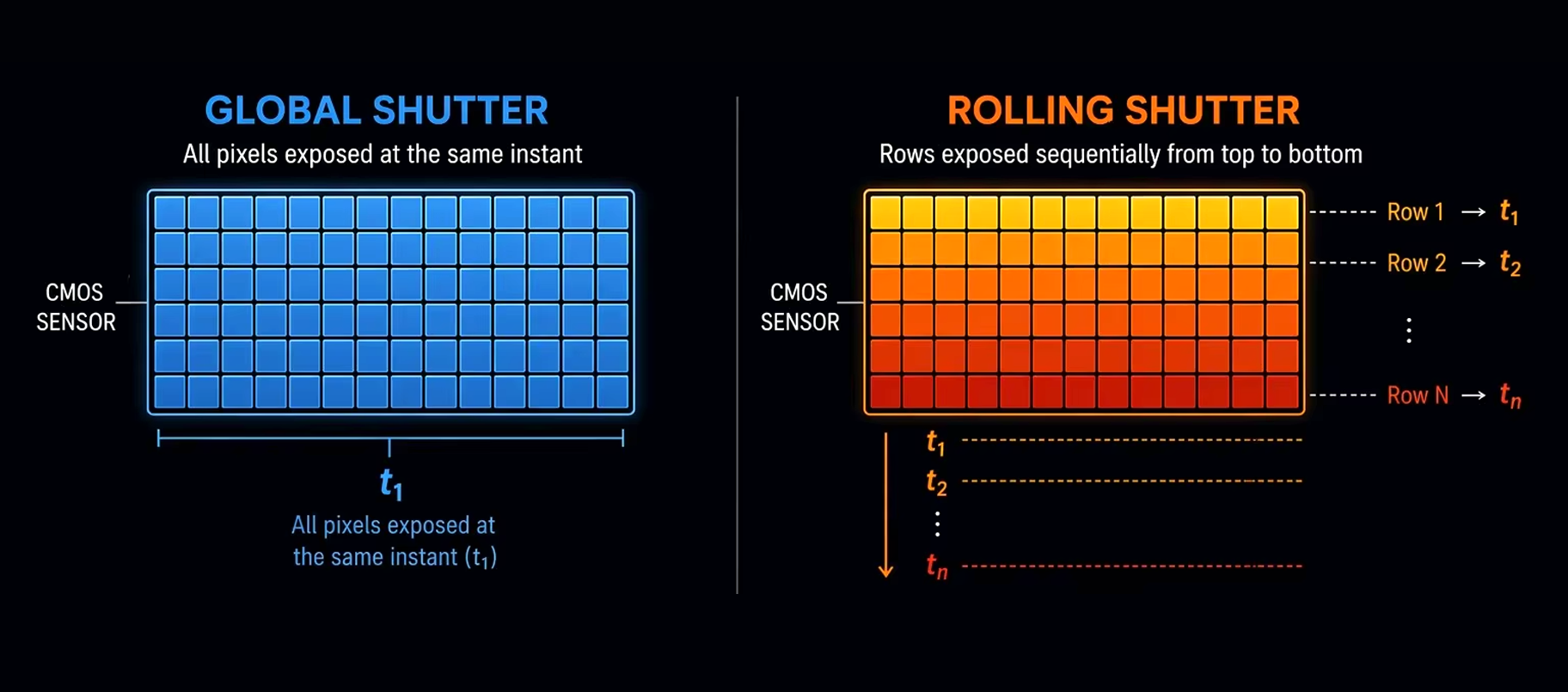
The short answer is yes: a global shutter machine vision camera eliminates motion blur more effectively than rolling shutter types in the vast majority of industrial inspection and automation scenarios. However, understanding exactly why this is the case, and when this advantage matters most, helps engineers and procurement teams make smarter purchasing decisions. This article breaks down the mechanics, practical benefits, and application suitability of the global shutter machine vision camera in direct comparison to its rolling shutter counterpart.
How Shutter Mechanisms Affect Image Clarity
The Core Difference in Pixel Exposure Timing
A global shutter machine vision camera captures all pixels at exactly the same instant. The sensor reads the entire frame at once, meaning no part of the image is captured earlier or later than another. This simultaneous exposure is what makes a global shutter machine vision camera so effective at freezing motion without introducing geometric distortion. In contrast, a rolling shutter sensor scans the image row by row from top to bottom, so different parts of the frame are exposed at slightly different times.
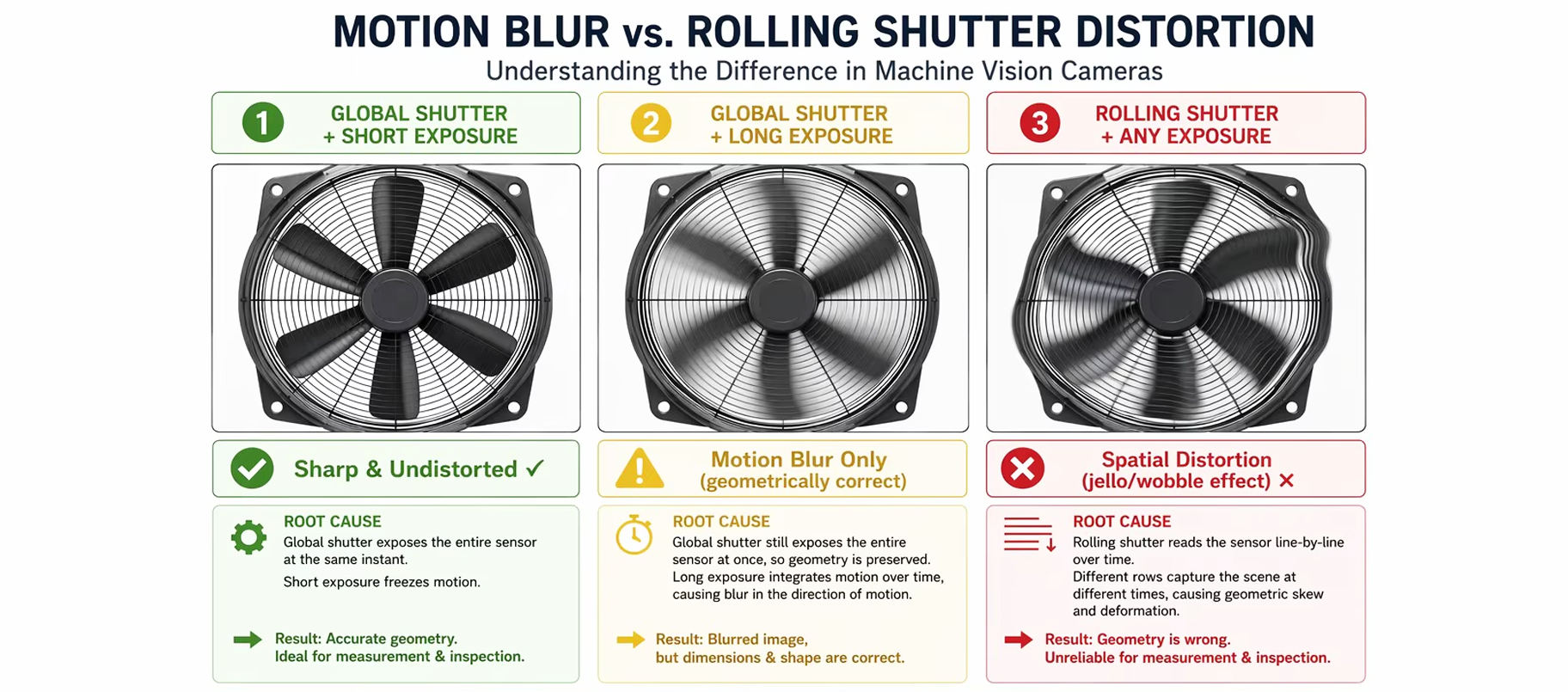
When a subject moves during this row-by-row scan, the resulting image records the object at different positions across different rows. The output from a rolling shutter sensor can exhibit skewing, wobble, or the well-known 'jello' effect. A global shutter machine vision camera avoids these artifacts entirely because the entire sensor area is sampled in a single synchronized moment, regardless of how fast the subject is moving.
Motion Blur vs. Rolling Shutter Distortion
Motion blur and rolling shutter distortion are two distinct problems that engineers often conflate. Motion blur occurs when the exposure duration is long enough for an object to move noticeably across the sensor during that window. A global shutter machine vision camera can still exhibit motion blur if the exposure time is set too long. However, by using a short exposure, the global shutter machine vision camera captures a sharp, undistorted snapshot because all pixels lock in simultaneously. Rolling shutter cameras, even with very short exposures, remain susceptible to geometric distortion whenever objects or the camera itself moves between row scans. This makes the global shutter machine vision camera the more reliable tool when motion is unavoidable.
Industrial Applications Where Global Shutter Excels
High-Speed Production Line Inspection
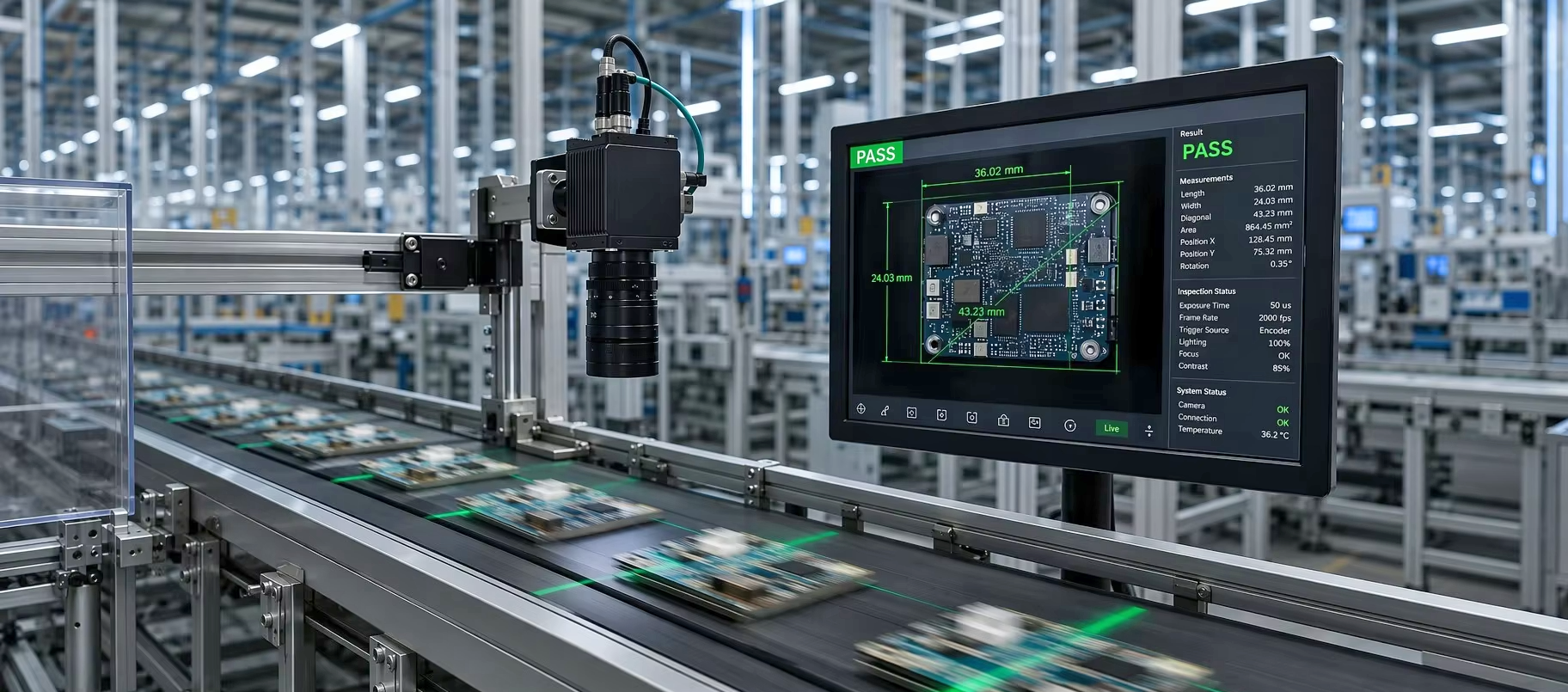
On a fast-moving production line, components, labels, and surface features pass the imaging station in milliseconds. A global shutter machine vision camera is ideally suited for these environments because it eliminates the distortion that would otherwise misrepresent the geometry of inspected parts. Whether the task involves barcode reading, dimensional measurement, or surface defect detection, the global shutter machine vision camera delivers consistent frame-to-frame accuracy that rolling shutter cameras simply cannot match under the same conditions.
The reliability of a global shutter machine vision camera in high-speed applications directly translates into lower false rejection rates and more dependable pass-fail decisions. When the inspection system is integrated with a robotic pick-and-place unit, the precise positional data provided by a global shutter machine vision camera ensures the robot responds correctly. Any spatial distortion introduced by a rolling shutter would propagate errors throughout the automated workflow.
Robotics, AGVs, and Moving Camera Platforms
Applications where the camera itself is in motion present an additional challenge. A global shutter machine vision camera mounted on a robotic arm or an autonomous guided vehicle captures clean images even while the platform is accelerating, decelerating, or vibrating. Rolling shutter sensors are particularly vulnerable in these scenarios because the camera body movement introduces the same row-timing discrepancy as subject motion. Engineers integrating vision systems into mobile platforms consistently favor the global shutter machine vision camera for this reason. The global shutter machine vision camera removes a significant variable from system calibration and simplifies the overall design of the vision pipeline.
When Rolling Shutter May Be Considered Instead
Static Scenes and Cost-Sensitive Deployments
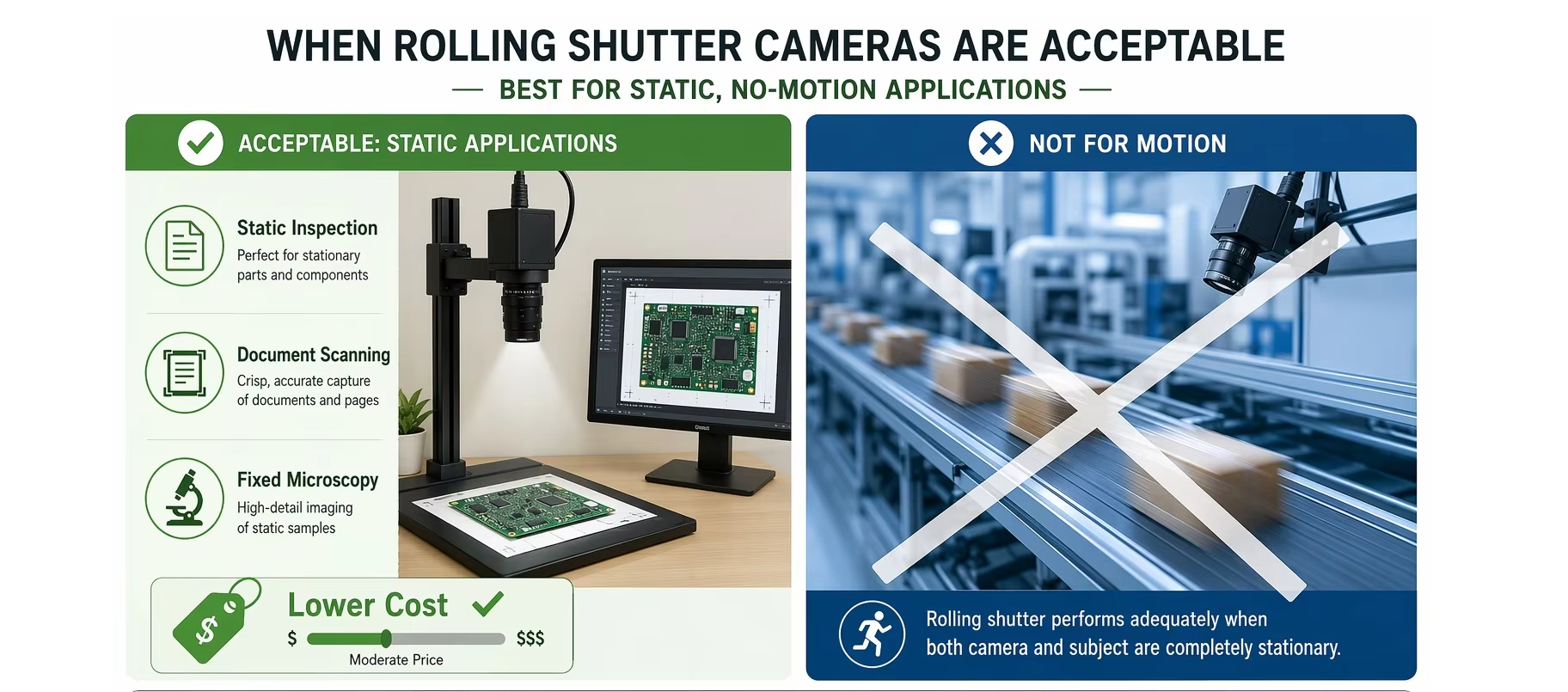
It would be inaccurate to suggest that a global shutter machine vision camera is the right choice for every application. In scenarios where both the camera and the subject are completely stationary, a rolling shutter camera can produce equally sharp and accurate images at a lower cost. Document scanning stations, fixed-focus quality checks on stationary products, and certain microscopy setups often involve no meaningful motion during the exposure window. In these cases, the rolling shutter camera performs adequately, and the additional expense of a global shutter machine vision camera may not be justified.
Cost is a genuine factor in large-scale deployments where dozens or hundreds of cameras are required. The global shutter machine vision camera tends to carry a higher price point due to its more complex sensor architecture. Procurement teams working under tight budget constraints sometimes evaluate whether the specific motion profile of their application genuinely demands a global shutter machine vision camera before committing to that choice.
Sensitivity and Dynamic Range Trade-offs
Rolling shutter sensors, particularly back-side illuminated designs, can offer superior light sensitivity in some configurations. A global shutter machine vision camera using front-side illuminated architecture may require higher illumination levels or longer exposure times to achieve equivalent signal quality in low-light conditions. However, many modern global shutter machine vision camera designs have narrowed this gap significantly. Engineers should evaluate the full system context, including lighting setup and ambient conditions, rather than assuming sensitivity alone determines the better choice.
FAQ
Does a global shutter machine vision camera always prevent motion blur?
A global shutter machine vision camera prevents rolling shutter distortion unconditionally, but motion blur can still occur if the exposure time is too long relative to subject speed. Using a sufficiently short exposure with a global shutter machine vision camera eliminates both distortion and blur simultaneously.
Is a global shutter machine vision camera suitable for color imaging?
Yes, a global shutter machine vision camera is available in both monochrome and color versions. Color global shutter machine vision camera models use Bayer pattern sensors and deliver accurate color reproduction on moving subjects without the color fringing that can appear on rolling shutter color sensors.
How do I choose the right global shutter machine vision camera resolution?
Choosing resolution for a global shutter machine vision camera depends on the field of view, the smallest feature that must be resolved, and the required frame rate. Higher resolution global shutter machine vision camera models provide finer detail but demand more bandwidth and processing power, so matching resolution to the actual inspection requirement is the most practical approach.