EN
EN


How to choose between CCD and CMOS sensors for a machine vision camera in low-light conditions?
Selecting the right sensor technology for a machine vision camera used in low-light environments is one of the most consequential decisions an engineer or procurement specialist will face. Whether you are deploying a machine vision camera on a dimly lit production line, inside an enclosed inspection chamber, or in an outdoor monitoring application with variable illumination, the sensor type at the heart of the camera will directly shape image quality, system reliability, and long-term operational cost. The choice between CCD and CMOS sensor architectures is not simply a technical preference — it is a decision with real engineering and financial implications for every machine vision camera deployment.
This article examines both sensor architectures from the perspective of a machine vision camera operating under low-light constraints. Understanding the fundamental differences in how each sensor captures and processes light will help you select the machine vision camera configuration that best meets your application requirements. From signal-to-noise ratio to read noise, dynamic range, and integration time, each factor plays a critical role when a machine vision camera must perform reliably in challenging lighting conditions.
How CCD and CMOS Sensors Differ in a Machine Vision Camera
Signal Architecture and Low-Light Sensitivity
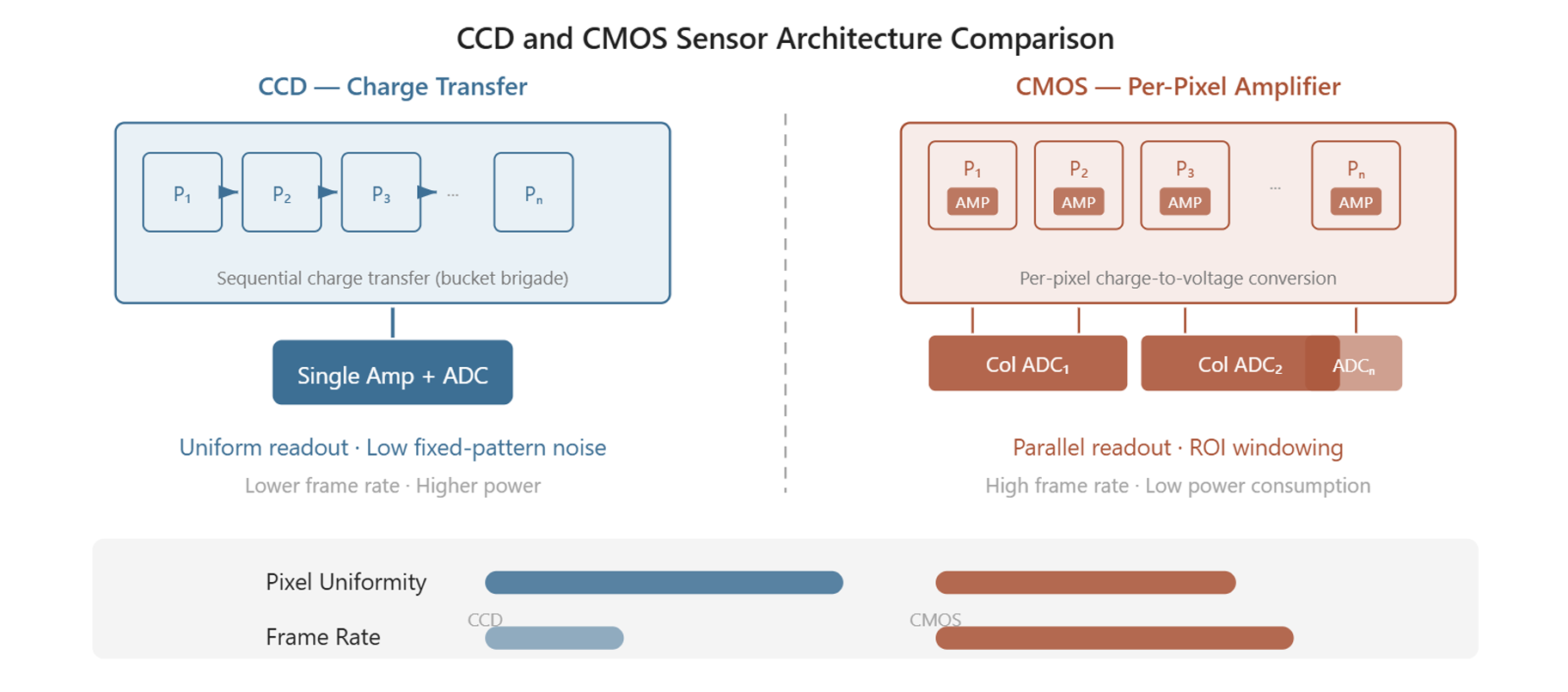
A CCD-based machine vision camera transfers charge from pixel to pixel across the sensor before converting it to voltage at a single output node. This architecture produces very uniform pixel response and low fixed-pattern noise, which are highly desirable traits when a machine vision camera must detect fine contrast differences in dim scenes. Because each pixel in a CCD machine vision camera shares one conversion node, the read noise remains consistently low across the entire sensor area. This makes a CCD machine vision camera particularly well suited to applications where absolute sensitivity and image uniformity matter more than processing speed.
A CMOS-based machine vision camera, by contrast, converts charge to voltage directly at each pixel using an in-pixel amplifier. This per-pixel conversion approach allows the machine vision camera to read out individual pixels or regions of interest, enabling much faster frame rates. However, early CMOS designs introduced higher read noise and greater pixel-to-pixel variation. Modern back-illuminated CMOS sensors used in today's machine vision camera designs have closed much of this gap, delivering sensitivity levels that rival CCD performance in many low-light scenarios.
Dynamic Range and Noise Performance
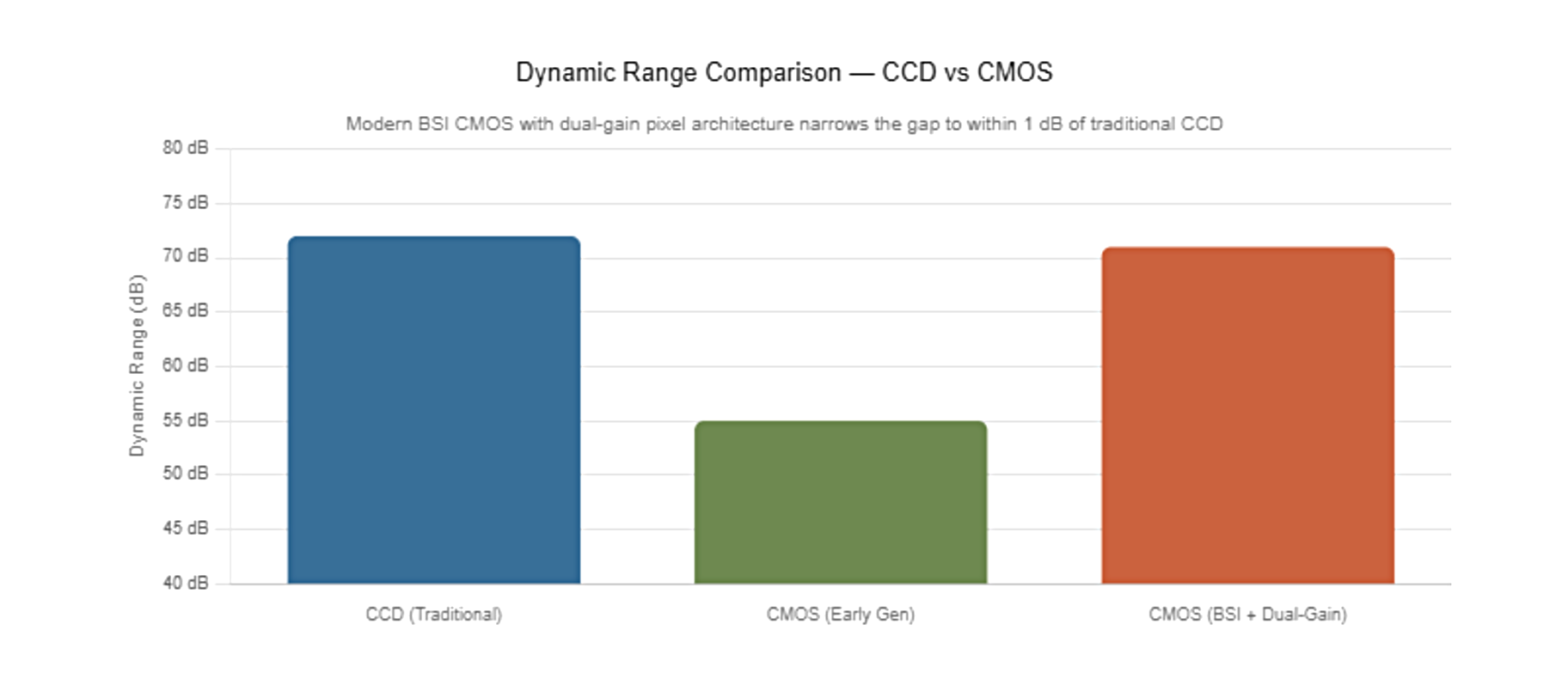
Dynamic range is a critical metric for any machine vision camera working in low-light or mixed-lighting environments. A machine vision camera with high dynamic range can capture both shadow detail and highlight detail in the same frame without clipping or noise floor interference. Traditional CCD sensors offer excellent dynamic range with predictable noise characteristics, making a CCD machine vision camera a dependable choice for controlled laboratory or pharmaceutical inspection environments. CMOS sensors in a modern machine vision camera can also achieve competitive dynamic range, particularly when global shutter and dual-gain pixel architectures are employed. For a machine vision camera operating on a fast-moving production line with variable lighting, a high-dynamic-range CMOS option may actually outperform a CCD solution by combining speed with adequate sensitivity.
Key Evaluation Criteria for Low-Light Machine Vision Camera Selection
Quantum Efficiency and Fill Factor
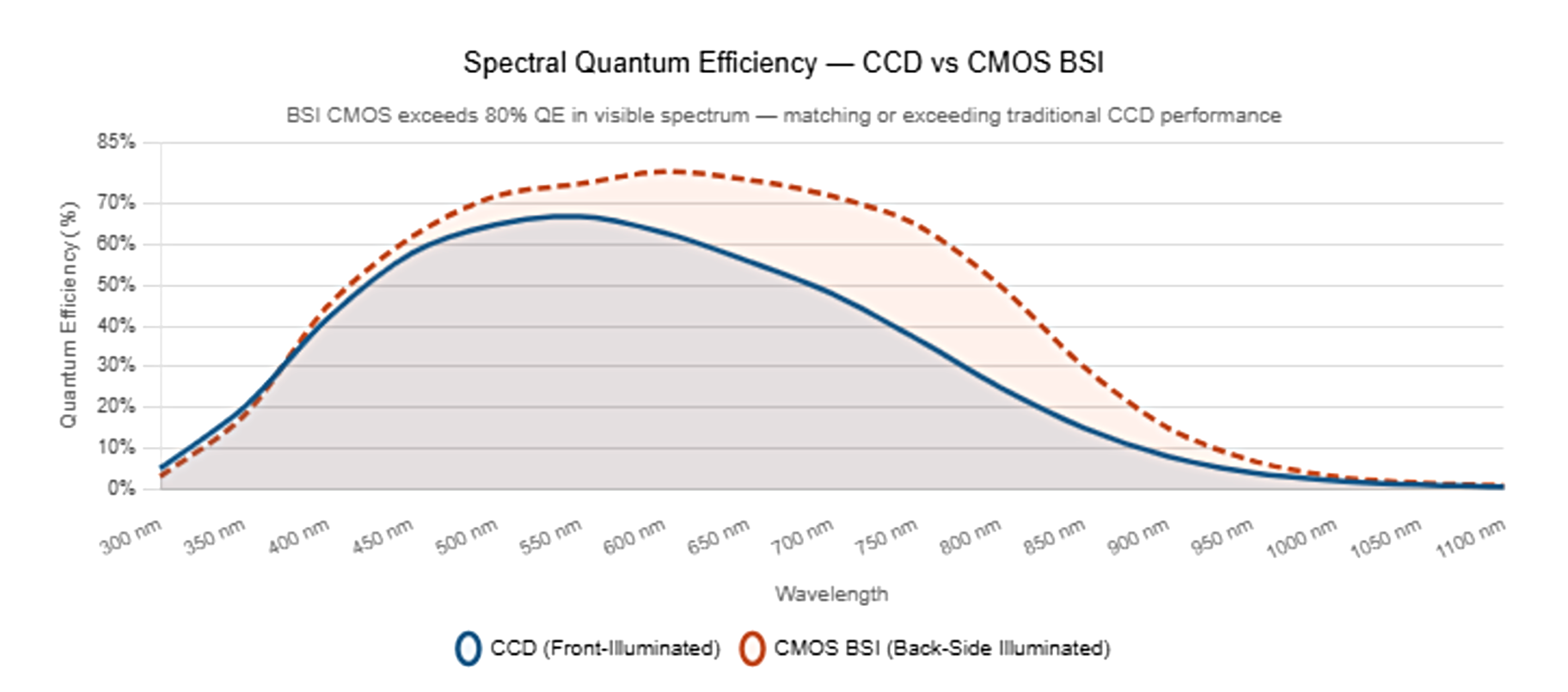
Quantum efficiency describes how effectively a machine vision camera sensor converts incoming photons into electrons. A machine vision camera with high quantum efficiency will produce a stronger signal from the same light level, which directly reduces the reliance on gain amplification and limits noise amplification. CCD sensors have historically led in quantum efficiency for scientific and industrial machine vision camera applications. However, back-side illuminated CMOS sensors used in current machine vision camera products can achieve quantum efficiency values above 80 percent in the visible spectrum, matching or exceeding many CCD-based alternatives. When evaluating a machine vision camera for low-light use, always request the spectral quantum efficiency curve from the vendor and compare it against your target wavelength range.
Integration Time and Motion Considerations
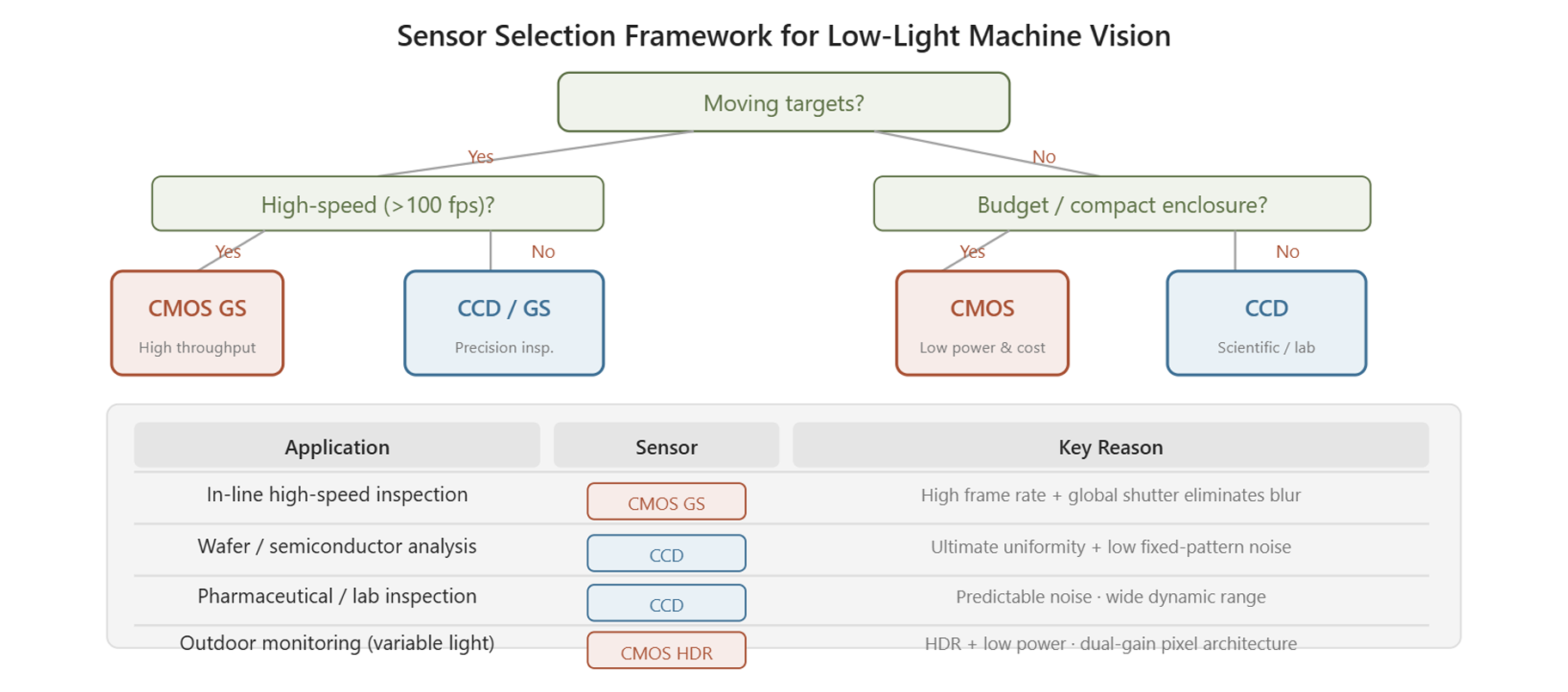
In low-light conditions, a machine vision camera often requires a longer integration time to accumulate sufficient signal. Longer exposure in a machine vision camera introduces motion blur risk when inspecting moving parts or objects. A CCD machine vision camera with a global shutter captures all pixels simultaneously, which eliminates the rolling shutter distortion that some CMOS designs produce. For applications where the machine vision camera must capture a moving target under low illumination, a global shutter machine vision camera — whether CCD or CMOS — is strongly recommended. Many industrial-grade CMOS machine vision camera models now include global shutter modes that preserve image integrity even at extended exposure settings.
Practical Decision Factors for Your Machine Vision Camera Application
Application Speed, Interface, and Total Cost
If your machine vision camera application demands high throughput — such as inline inspection at hundreds of parts per minute — a CMOS machine vision camera generally offers the processing speed advantage. A CCD machine vision camera typically operates at lower frame rates due to its sequential charge transfer architecture. For slower, high-precision inspection tasks such as wafer analysis or document verification, a CCD machine vision camera may still be preferred. Cost is also a relevant factor: CMOS machine vision camera modules have become significantly more affordable due to high-volume consumer and mobile manufacturing, making them the economical choice for most new machine vision camera deployments.
Environmental and Long-Term Reliability Factors
A machine vision camera deployed in an industrial setting must withstand vibration, temperature variation, and continuous operation. CMOS sensors used in modern machine vision camera designs consume less power and generate less heat than CCD alternatives, which contributes to longer sensor lifespan and reduced thermal noise accumulation. Lower power draw also makes a CMOS machine vision camera more compatible with compact enclosures where thermal management is limited. For a machine vision camera expected to run continuously in a harsh industrial environment, the thermal and power advantages of a CMOS sensor should factor heavily into your selection process.
FAQ
Is a CCD machine vision camera always better for low-light applications?
Not necessarily. A CCD machine vision camera traditionally offers lower read noise and high uniformity, which benefits low-light performance. However, modern back-illuminated CMOS machine vision camera sensors have achieved comparable sensitivity levels. The best choice depends on your specific application speed, budget, and integration time requirements rather than sensor type alone.
Can a CMOS machine vision camera match CCD image quality in dim conditions?
Yes, in many cases a CMOS machine vision camera using current back-side illuminated sensor technology can deliver image quality that matches or approaches that of a CCD machine vision camera in low-light conditions. Evaluate the quantum efficiency curve, read noise specification, and dynamic range data for each machine vision camera model under consideration before making a final decision.
What is the most important specification when choosing a machine vision camera for low-light use?
Read noise and quantum efficiency are the two most critical specifications for a machine vision camera in low-light conditions. A machine vision camera with low read noise and high quantum efficiency will produce the cleanest signal from minimal available light. Dynamic range and shutter type are also important depending on whether your machine vision camera must capture moving targets or scenes with mixed illumination levels.