EN
EN


Which lens mount (C-mount or F-mount) fits your machine vision camera for large sensors?
Selecting the correct mount for a machine vision lens is one of the most important hardware decisions you will make when building a high-performance imaging system. As sensor sizes grow larger in modern industrial cameras, the mount type directly affects image quality, coverage, and long-term system compatibility. Understanding the differences between C-mount and F-mount is essential before you commit to any machine vision lens for your application.
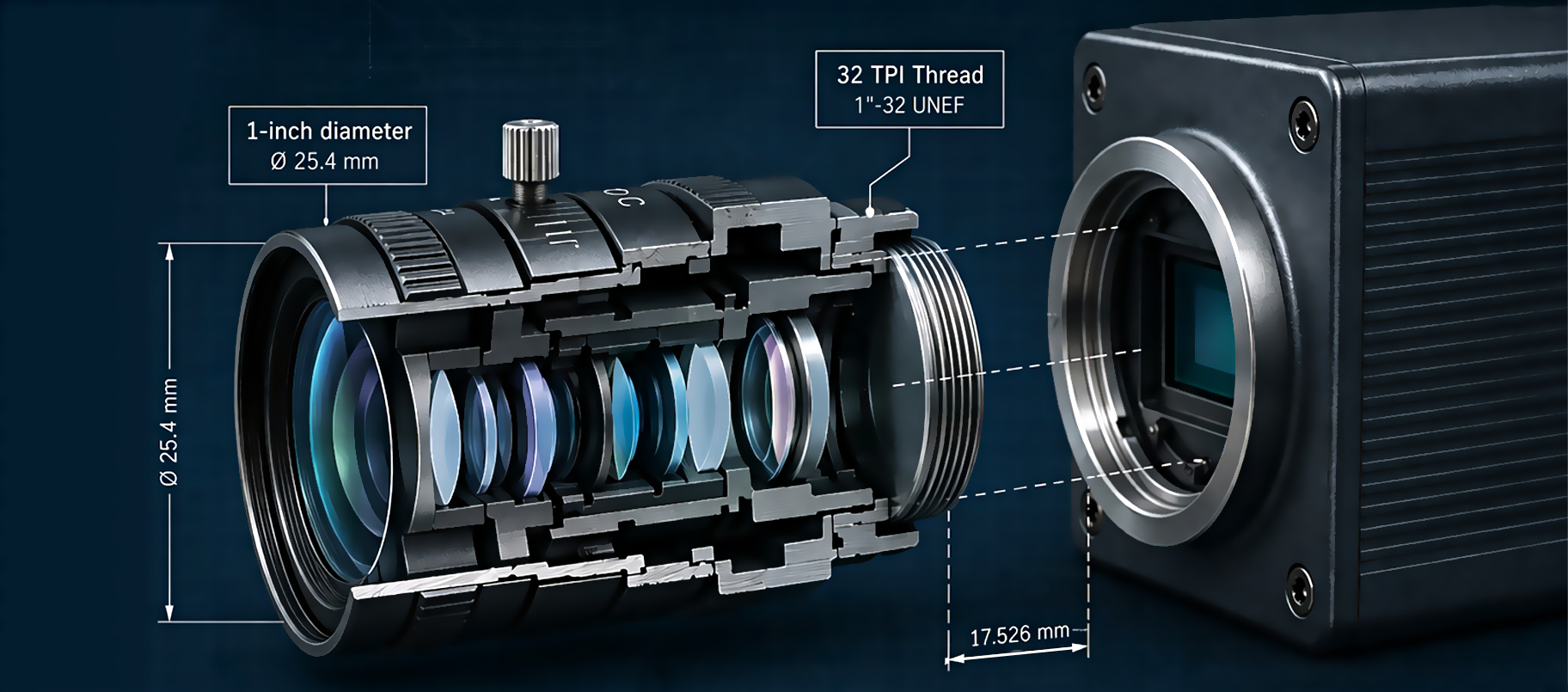
A machine vision lens performs optimally only when it is paired with a compatible mount and a sensor it can fully cover. With the rapid adoption of high-resolution, large-format sensors in industrial inspection, factory automation, and scientific imaging, the gap between C-mount and F-mount capabilities has become a decisive factor. This guide breaks down the physical and optical differences between the two mount standards and helps you determine which machine vision lens mount fits your camera and sensor size.
Understanding C-Mount and F-Mount Standards
The C-Mount Machine Vision Lens
The C-mount is the traditional standard for industrial imaging, and it remains one of the most widely used interfaces for a machine vision lens today. A C-mount machine vision lens features a 1-inch diameter thread with a 32 threads-per-inch pitch and a flange focal distance of 17.526 mm. This compact design makes a C-mount machine vision lens well suited for smaller camera bodies and light, cost-effective imaging setups. Most entry-level and mid-range industrial cameras accept a C-mount machine vision lens without any adapter.
However, a C-mount machine vision lens has a limited image circle. Standard C-mount specifications support an image circle of up to approximately 1 inch, which translates to sensors in the 1-inch format range. When a machine vision lens with a C-mount interface is paired with a sensor that exceeds this image circle, vignetting and corner darkening become serious problems. For large-format sensors, a standard C-mount machine vision lens will often fail to deliver uniform illumination across the full sensor area.
The F-Mount Machine Vision Lens
The F-mount, originally developed for 35 mm film SLR cameras, has become a popular standard in industrial imaging precisely because it supports large-format sensors. An F-mount machine vision lens uses a bayonet-style interface with a flange focal distance of 46.5 mm. The larger mount diameter of an F-mount machine vision lens allows it to project a much wider image circle, commonly covering sensors from 1.1 inches up to full-frame 35 mm formats. This makes the F-mount machine vision lens the preferred choice for high-resolution cameras used in semiconductor inspection, flat-panel display testing, and large-area web inspection.
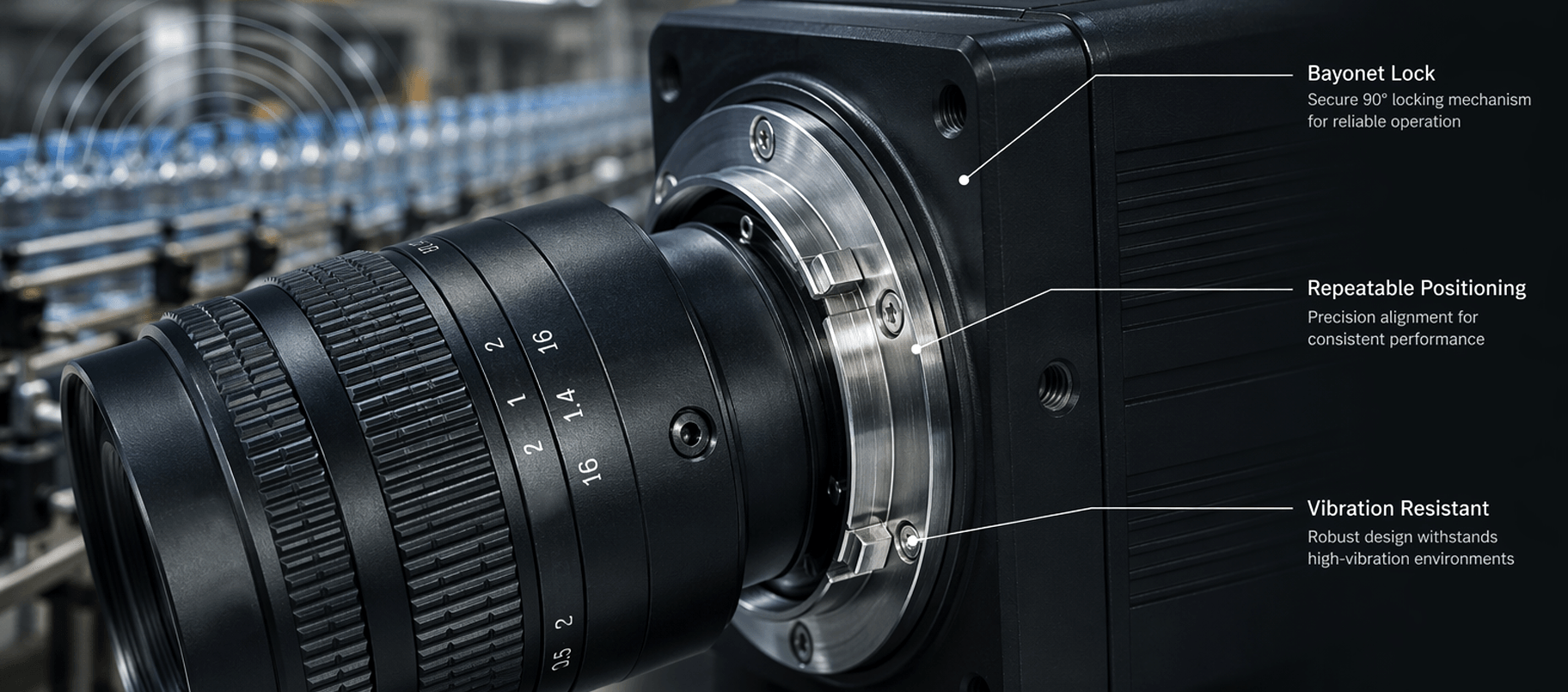
An F-mount machine vision lens typically offers greater mechanical rigidity as well. The bayonet locking mechanism of an F-mount machine vision lens provides more stable, repeatable positioning compared to screw-thread mounts, which is critical in vibration-prone production environments. When you need a machine vision lens that stays in precise alignment during continuous operation, the F-mount design offers clear advantages.
Sensor Size and Image Circle Coverage
Why Sensor Size Determines Your Machine Vision Lens Mount Choice
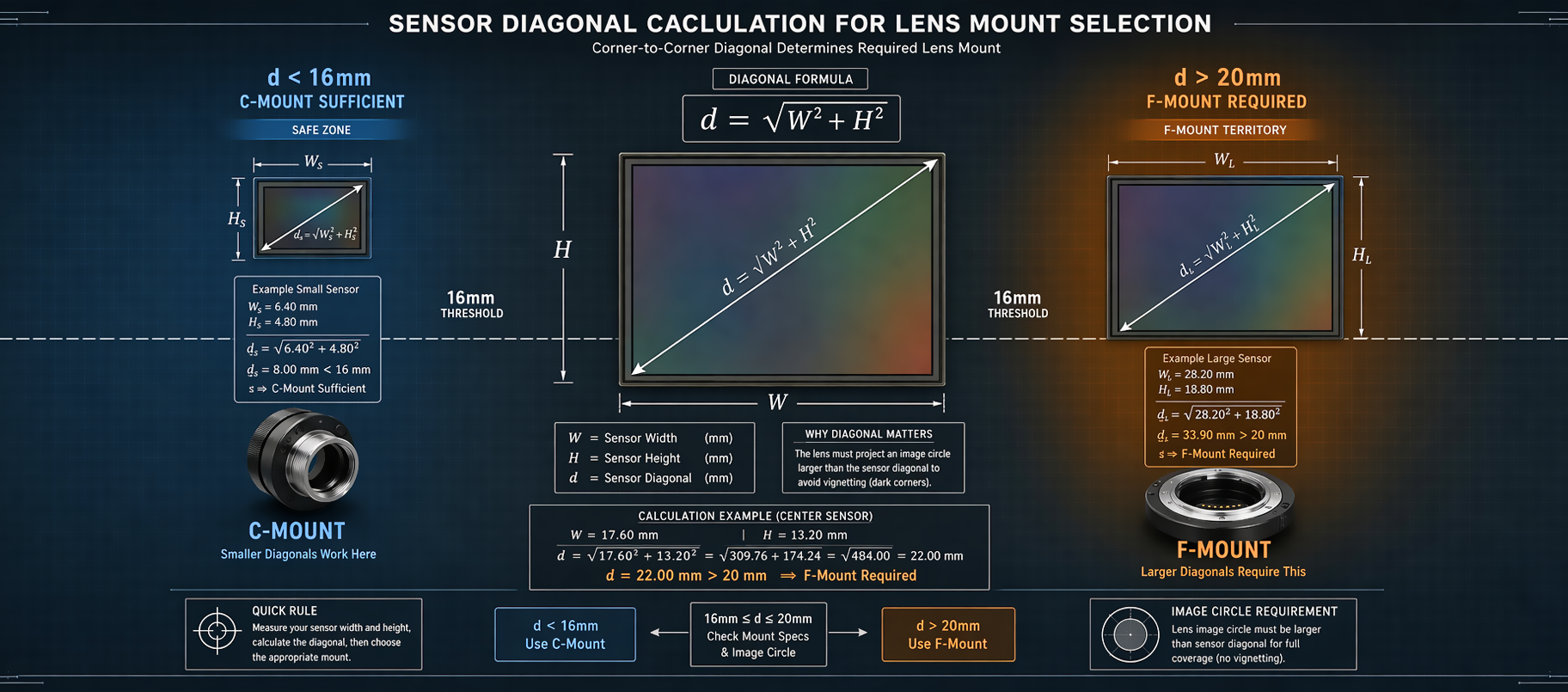
The image circle of a machine vision lens must equal or exceed the diagonal measurement of the sensor it covers. If you are using a 1/2-inch or 2/3-inch sensor, a C-mount machine vision lens is typically sufficient. These smaller sensors are well within the coverage capability of a standard C-mount machine vision lens, and the compact format keeps system cost low. For applications where sensor size is moderate, a C-mount machine vision lens remains a practical and economical choice.
Once your camera uses a sensor larger than 1 inch, the situation changes significantly. A machine vision lens with a C-mount interface will struggle to cover a 4/3-inch, APS-C, or full-frame sensor without corner vignetting. In these cases, an F-mount machine vision lens becomes the technically correct solution. The F-mount machine vision lens projects a larger image circle that covers the full sensor diagonal, preserving sharpness and uniformity all the way to the image corners. Choosing the wrong machine vision lens mount for your sensor size will compromise measurement accuracy and defect detection performance.
Calculating Image Circle Requirements for a Machine Vision Lens
Before selecting a machine vision lens, calculate the sensor diagonal using the width and height of the active sensor area. If your sensor diagonal exceeds 16 mm, you are likely moving into territory where only an F-mount machine vision lens will provide full coverage. Many modern high-resolution sensors used with a machine vision lens in precision inspection exceed 20 mm diagonally, making the F-mount machine vision lens the standard for these platforms. Always verify the image circle specification in the machine vision lens datasheet before finalizing your hardware selection.
Practical Selection Criteria for Your Application
When to Choose a C-Mount Machine Vision Lens
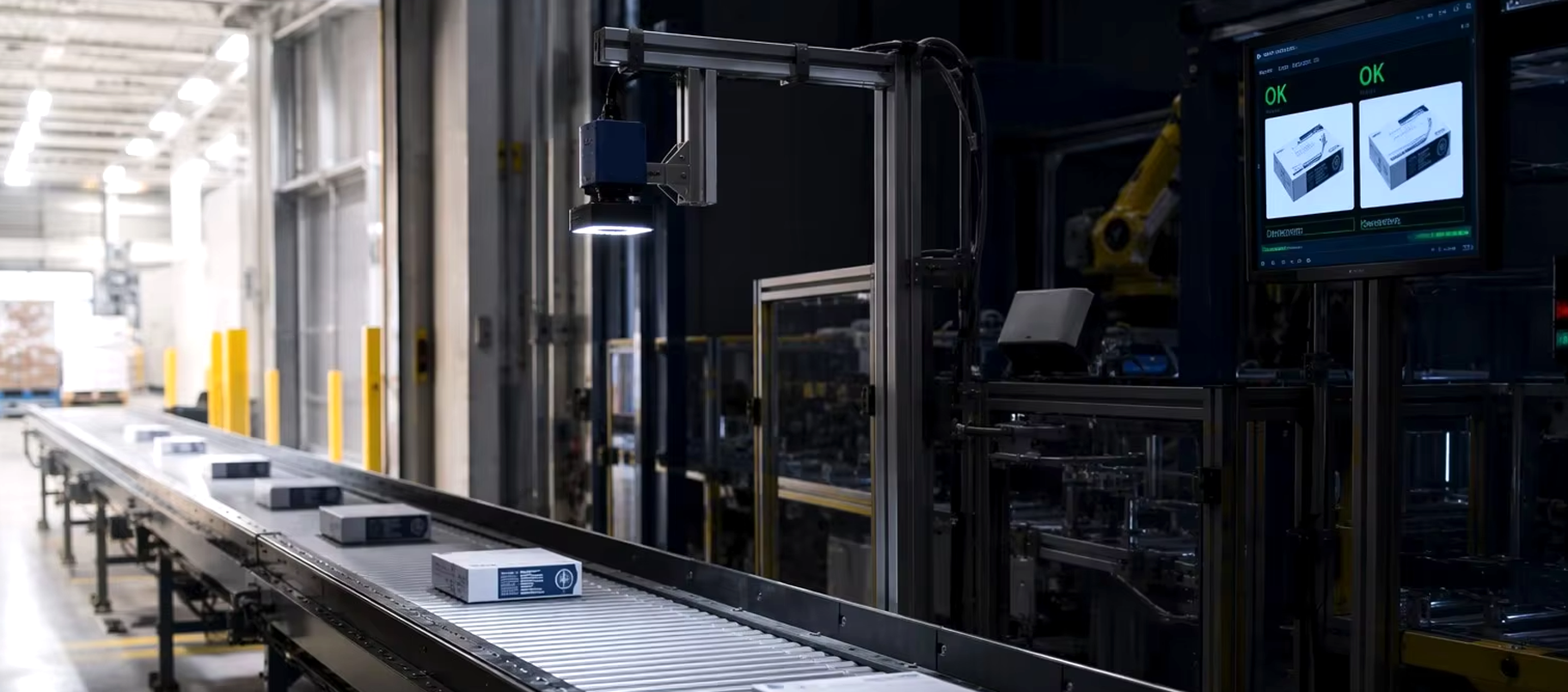
A C-mount machine vision lens is the right choice when your camera uses a sensor of 1 inch or smaller, when system weight and compactness matter, and when you need cost-effective coverage. Production-line cameras used for label inspection, barcode reading, or component presence verification often use a C-mount machine vision lens because sensor sizes in these applications remain modest. The wide availability of C-mount machine vision lens options across different focal lengths and apertures makes sourcing flexible and affordable.
When to Choose an F-Mount Machine Vision Lens
An F-mount machine vision lens is the correct selection for large-sensor cameras used in demanding inspection tasks. If your system uses a 5-megapixel or higher camera with a large-format sensor, an F-mount machine vision lens delivers the image circle and optical performance required. Applications such as PCB inspection, solar cell imaging, and automated optical inspection of large surfaces rely on an F-mount machine vision lens to maintain edge-to-edge resolution. When throughput, accuracy, and sensor investment are all high, the F-mount machine vision lens protects both image quality and return on investment.
FAQ
Can a C-mount machine vision lens work with an F-mount camera?
A C-mount machine vision lens cannot directly attach to an F-mount camera body without an adapter, and even with an adapter the image circle of a C-mount machine vision lens will be insufficient for the larger sensor. You will experience significant vignetting. For large-sensor cameras, always choose an F-mount machine vision lens designed for the required image circle.
What is the maximum sensor size a C-mount machine vision lens can cover?
A standard C-mount machine vision lens is designed to cover sensors up to the 1-inch format, which has a diagonal of approximately 16 mm. Some specialized large-format C-mount machine vision lens designs extend coverage slightly beyond this, but for sensors above 1 inch, an F-mount machine vision lens is the more reliable and optically correct option.
Does the machine vision lens mount affect focal length selection?
Yes, the mount type influences the available focal lengths for your machine vision lens. F-mount machine vision lens options include a broader range of focal lengths suited for large sensors and longer working distances. C-mount machine vision lens focal lengths tend to be shorter due to the smaller sensor formats they serve. Always select a machine vision lens focal length that matches both your working distance and your sensor size simultaneously.