EN


Machine Vision Light Controller Review for B2B Buyers
For a machine-vision project, the light head often receives most of the attention. In practice, however, the machine vision light controller determines whether that light delivers repeatable illumination at the moment the camera exposes. For procurement teams, system integrators, and quality engineers, that makes the controller a system component—not an accessory.
This review avoids ranking brands by a single headline specification. It explains how B2B buyers can assess a machine vision light controller against the light, camera, trigger, motion profile, and service conditions of the intended inspection cell. The most suitable option is the one with verified electrical compatibility, predictable timing, and enough operating margin for production—not simply the highest peak-current figure.
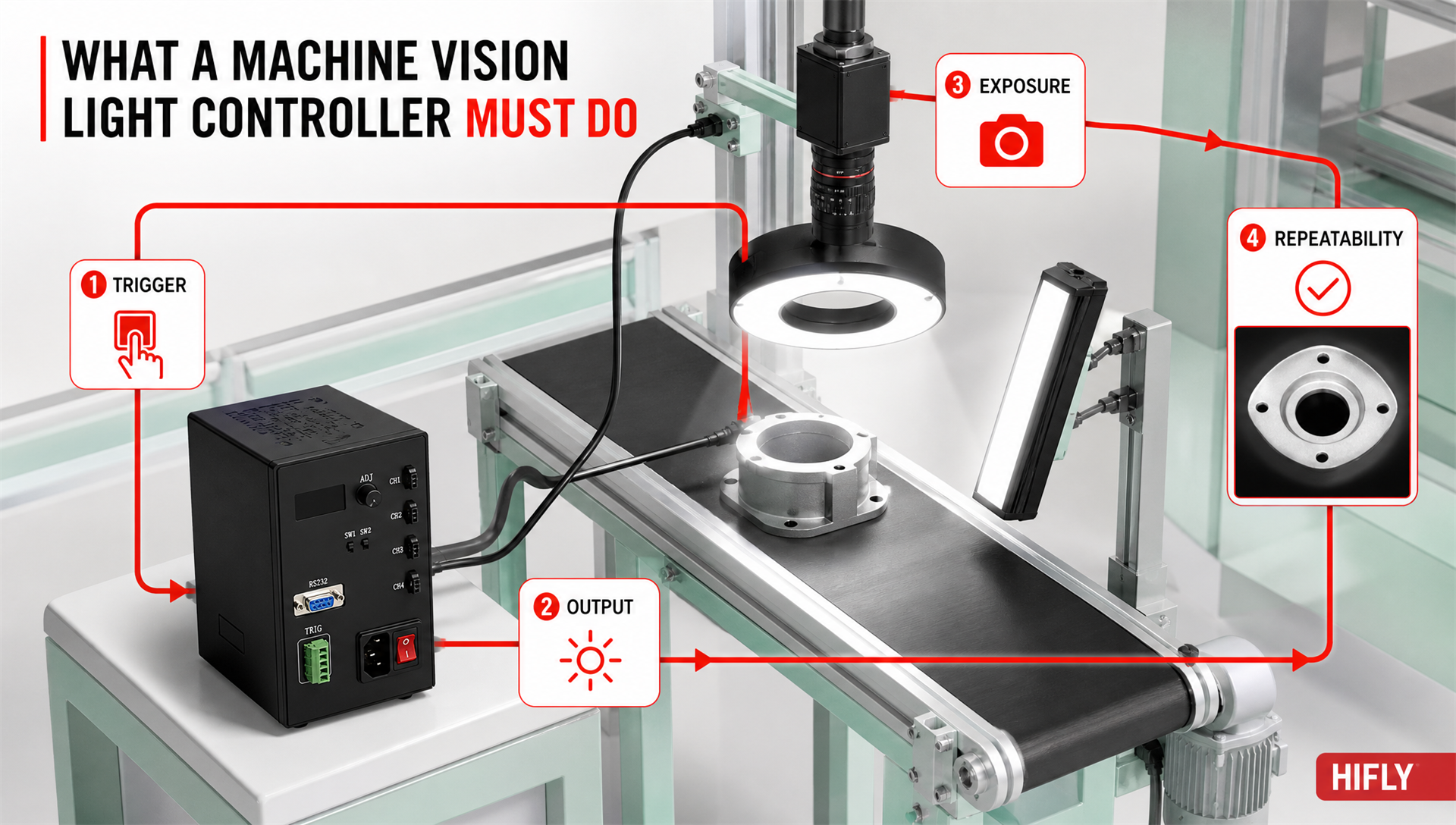
What a Machine Vision Light Controller Must Do
A machine vision light controller regulates LED output in continuous or pulsed operation and coordinates illumination with camera and trigger events. It can stabilize output as operating conditions change, set intensity, and create short strobe pulses to freeze motion or improve contrast. The controller therefore affects image consistency, exposure flexibility, LED loading, and ultimately the robustness of the inspection decision.
The B2B Review Framework: Seven Criteria That Matter
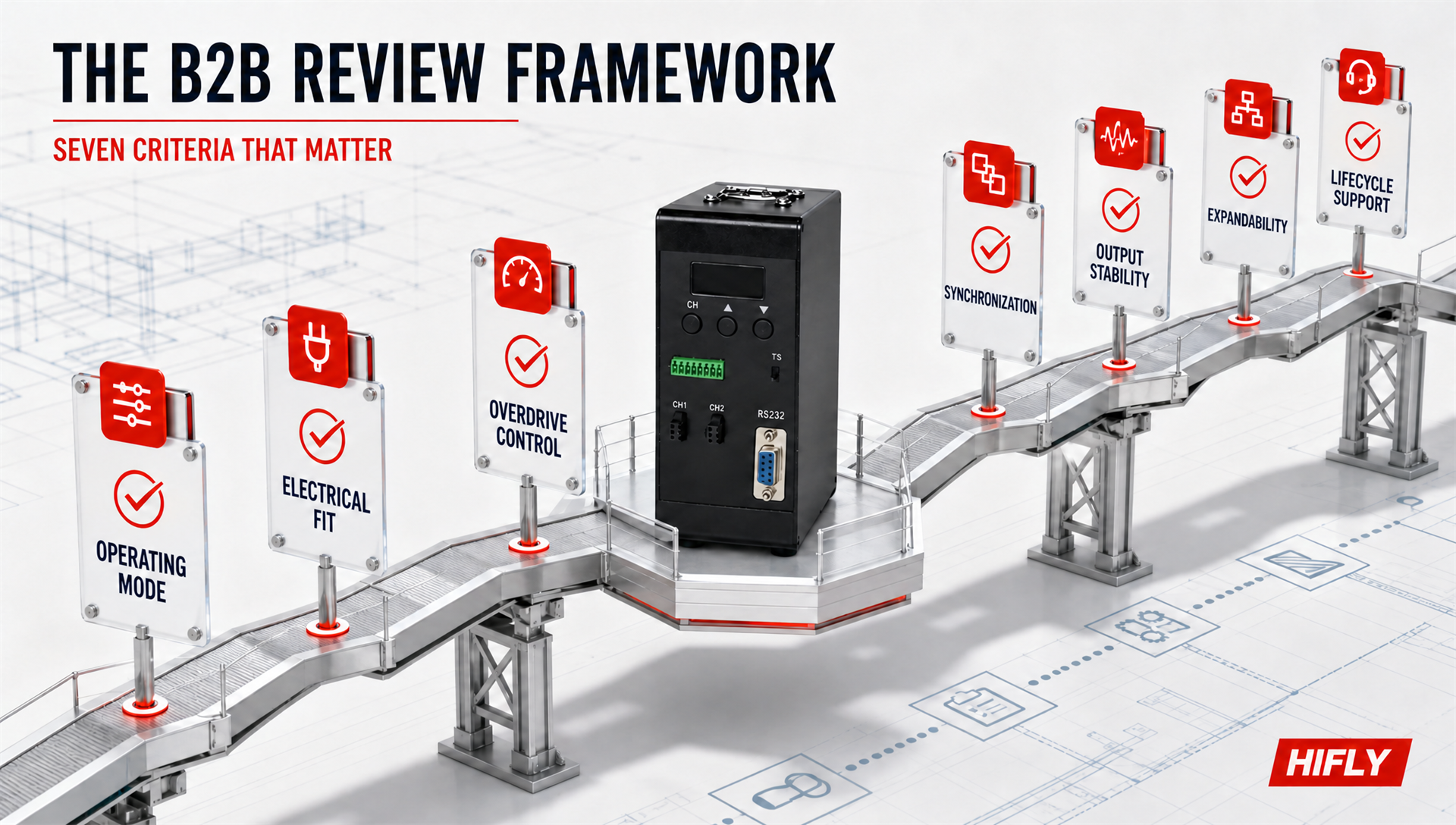
1. Match output mode to the inspection motion
Start by deciding whether the application needs continuous illumination, triggered strobe operation, or both. Continuous mode can suit stationary parts, setup work, or applications with a sufficiently long exposure. Strobe mode is more relevant when moving parts must be captured sharply or when ambient light must be suppressed through a tightly timed exposure window.
For a strobe-capable machine vision light controller, ask for the supported pulse-width range, trigger latency, timing repeatability, and behavior at the planned repetition rate. Do not accept “high speed” as a complete answer. Your camera exposure, trigger topology, and light response must all be evaluated together.
2. Verify voltage, current, and light-head compatibility together
Peak current alone does not tell a buyer whether a controller will produce the required optical result. The light head’s LED configuration, cable length, voltage requirement, thermal design, and pulse-width limits all affect the usable operating window. A technical lighting guide found during research notes that controller voltage can restrict the current available to a light, which can in turn limit achievable output.
Request a compatibility statement or characterized operating curve for the proposed light-and-controller pair. The acceptance record should list the light model, controller channel, operating voltage, maximum continuous current, maximum pulsed current, pulse width, repetition rate, and permitted duty cycle. This is much more useful than comparing controller data sheets in isolation.
3. Treat strobe overdrive as a controlled operating condition
Strobe overdrive can produce a brighter short pulse than continuous operation, but it is not a free performance upgrade. Published machine-vision lighting guidance describes low-duty-cycle strobing as a way to let LEDs dissipate heat between pulses; it cites roughly 0.1% to 2% as a common operating range, subject to the specific light and thermal design. The same source notes that many demanding overdrive applications use pulse widths in the approximate 50–500 microsecond range.
Use those figures as review prompts rather than universal specifications. A good machine vision light controller should make timing and current limits clear, while the supplier should confirm safe operation for the exact illuminator. Buyers should also recognize diminishing returns: increasing current may create heat faster than useful optical output.
4. Check trigger and camera synchronization before purchase
A controller should fit the cell’s trigger architecture. Confirm whether it accepts the available input signal, whether it offers pass-through or independently programmed pulse timing, and whether its I/O logic levels match the camera, PLC, or encoder interface. If several cameras or lights share a station, clarify channel independence and any timing constraints between channels.
5. Evaluate output stability and production repeatability
Inspection algorithms depend on a stable image baseline. Variations in illumination can change contrast and shift gray-level thresholds even when the part itself has not changed. Review the controller’s current-regulation approach, adjustment resolution, warm-up behavior, and any monitoring or fault indication available for production support.
6. Assess channel count and expandability as a sourcing decision
For buyers sourcing a broader imaging system, an integrated supplier can reduce compatibility work across lights, cameras, lenses, and controllers. HIFLY offers a machine-vision product ecosystem that covers these component categories, which can be useful when the project team wants coordinated specification support. That advantage should still be validated through the same application tests and documentation requirements applied to any supplier.
7. Review usability, diagnostics, and lifecycle support
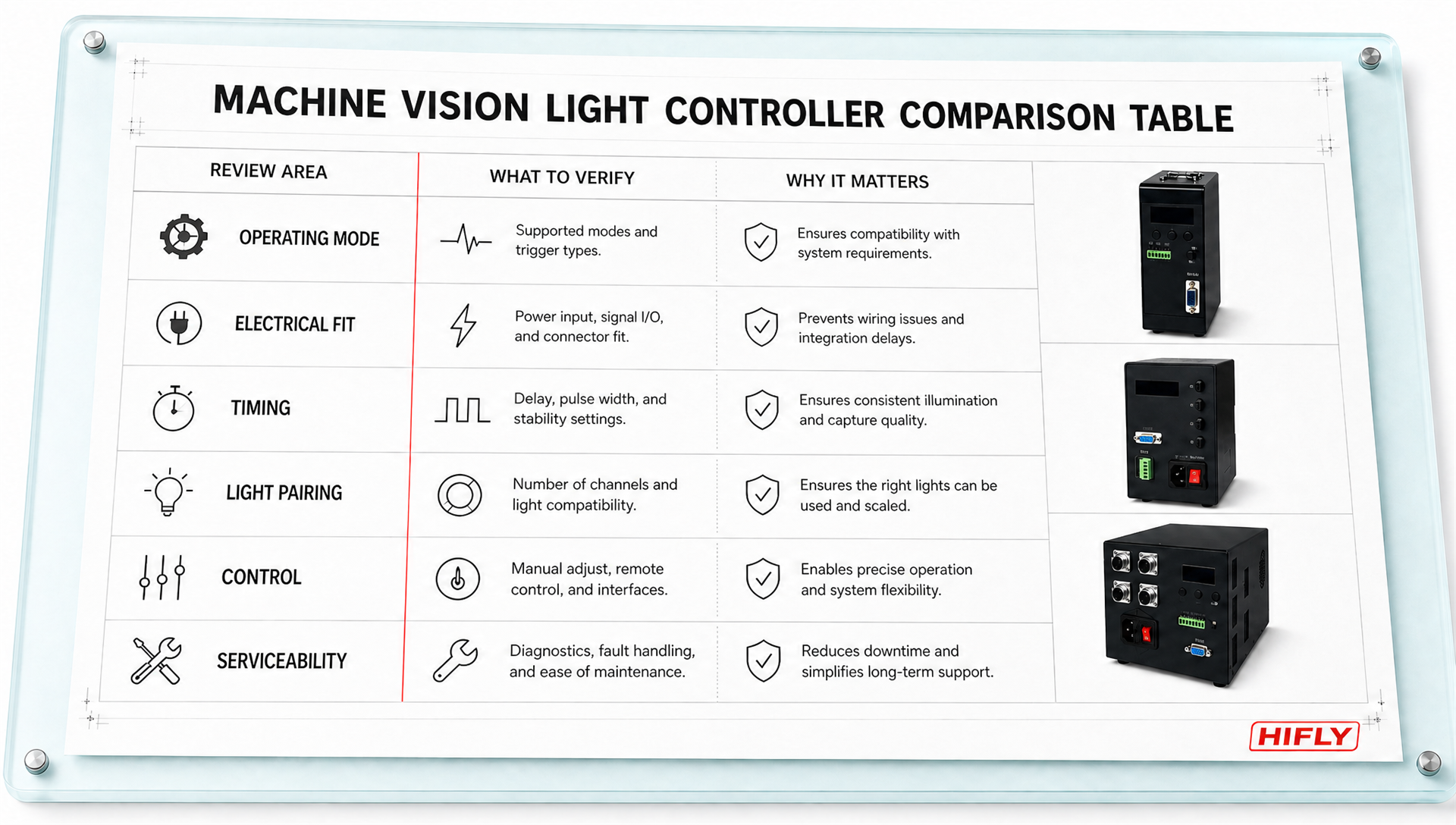
Machine Vision Light Controller Comparison Table
| Review area | What to verify | Why it matters |
|---|---|---|
| Operating mode | Continuous, strobe, or mixed-mode support | Aligns illumination with part motion and exposure needs |
| Electrical fit | Voltage, continuous/pulse current, channel loading | Prevents under-driven lights and avoidable LED stress |
| Timing | Trigger latency, pulse-width range, jitter, repetition limits | Protects image capture consistency at line speed |
| Light pairing | Supplier-characterized controller and light combination | Turns data-sheet claims into usable optical performance |
| Control | Adjustment resolution, remote I/O, stored settings | Supports repeatable setup and controlled changeovers |
| Serviceability | Diagnostics, connectors, documentation, spares | Reduces downtime and simplifies maintenance |
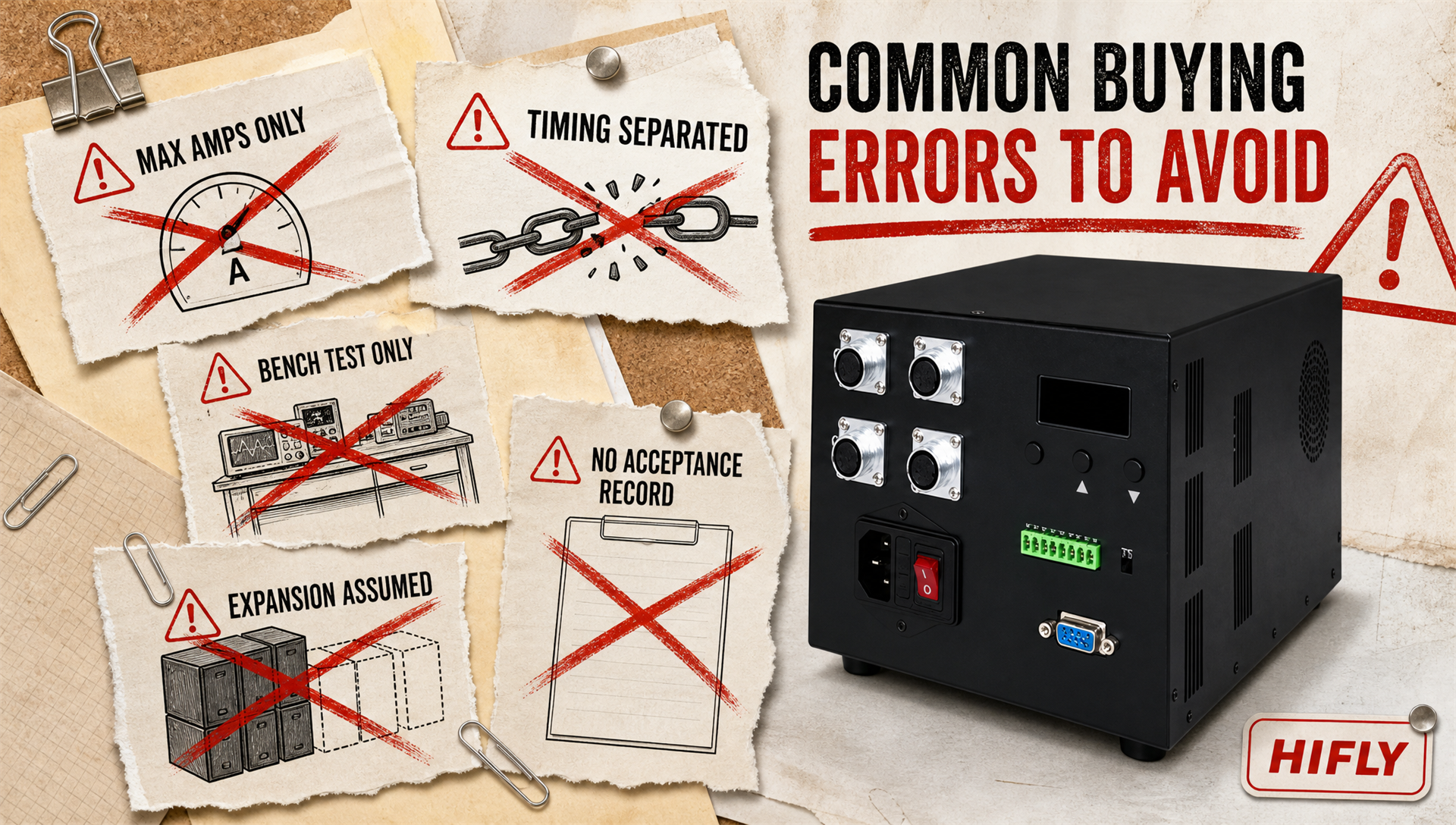
Common Buying Errors to Avoid
- Buying by maximum amps only: A high-current controller is not automatically compatible with the selected light or duty cycle.
- Separating lighting from camera timing: The controller, trigger, exposure, and light response must work as one chain.
- Testing only at a bench: Validate under real motion, ambient light, production temperature, and part variation.
- Ignoring the acceptance record: Document the settings and limits used to achieve the approved image so the cell can be restored after maintenance.
-
Assuming future expansion is free: Confirm channel loading, power budget, wiring, and configuration limits before committing to a platform.
A Practical RFQ Checklist
- Describe the inspected feature, part material, field of view, and line speed.
- Provide the selected or proposed light model, wavelength, geometry, and cable length.
- State camera exposure, trigger source, I/O levels, and synchronization requirement.
- Ask for continuous and pulsed electrical limits for the exact light-controller combination.
- Request a timing diagram, recommended settings, and duty-cycle guidance for the intended cycle rate.
- Define pass/fail image criteria and a representative production validation test.
- Confirm documentation, support path, warranty, spare availability, and change-control process.
Final Verdict for B2B Buyers
The appropriate machine vision light controller is the one that makes the approved image reproducible under real production conditions. It should provide the required current and timing within the safe limits of the light head, synchronize predictably with the camera, and give technicians enough visibility to maintain the setup. A practical B2B review considers electrical compatibility, timing evidence, stability, integration, and support together.
Before issuing a purchase order, ask suppliers to evaluate the controller with the actual light and application conditions. That final validation is the most reliable way to turn a controller comparison into a lower-risk vision-system decision.