EN
EN


Machine Vision Light Buying Guide for Wholesale Buyers
Buying a machine vision light in small quantities is very different from purchasing lighting for OEM production, distribution, or recurring industrial projects. Wholesale machine vision lighting buyers must evaluate more than just brightness. Product consistency, specifications, system compatibility, customization, capacity, and total cost all dictate the success of a bulk order.
A lighting solution that performs well in a prototype may not suit dozens or hundreds of systems. As order volumes scale, minor performance or dimensional variances become major operational issues.
For distributors, OEMs, and integrators, the right procurement strategy makes industrial vision lighting easy to standardize and deploy. The goal is balancing imaging performance, compatibility, supply stability, and overall value.
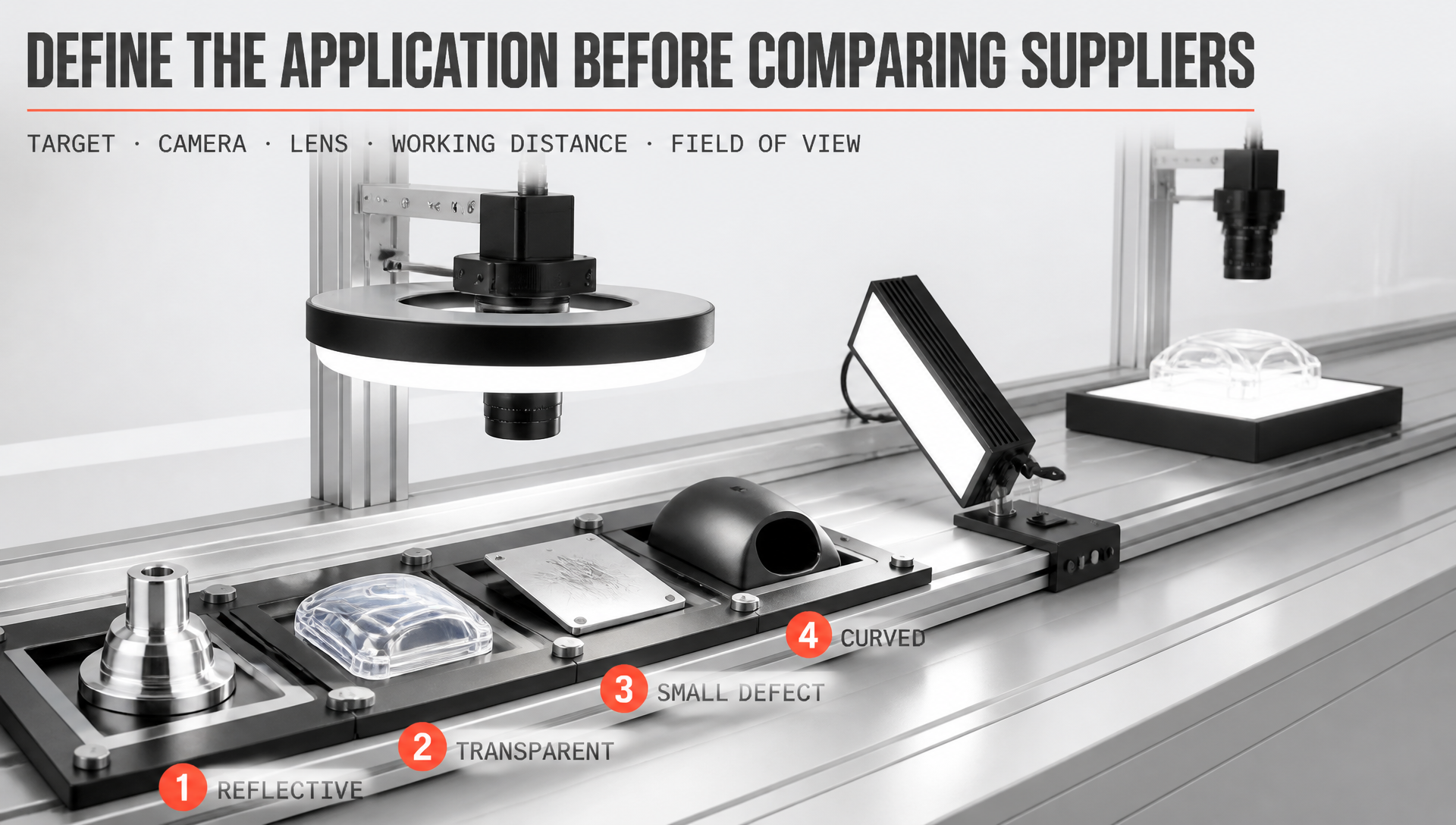
Define the Application Before Comparing Suppliers
Identify the Inspection Target
What will the lighting inspect? This is the primary question to answer before requesting quotes. Flat components work well with ring lighting, while long objects or conveyor systems benefit from bar or line scan illumination.
Reflective metals create glare under direct light, whereas transparent materials require backlighting to emphasize edge profiles. Small defects need directional light for contrast, and curved targets require diffuse illumination. Select a machine vision light based on inspection features rather than price alone.
Determine Camera and Lens Requirements
Lighting cannot be evaluated apart from the camera and lens. Field of view, sensor size, exposure settings, and working distance all dictate illumination specs.
Wholesale buyers should collect key parameters from engineering teams: working distance affects light coverage, field of view determines illumination area, lens position influences reflection, camera sensitivity sets intensity needs, and line speed dictates continuous versus strobe lighting.
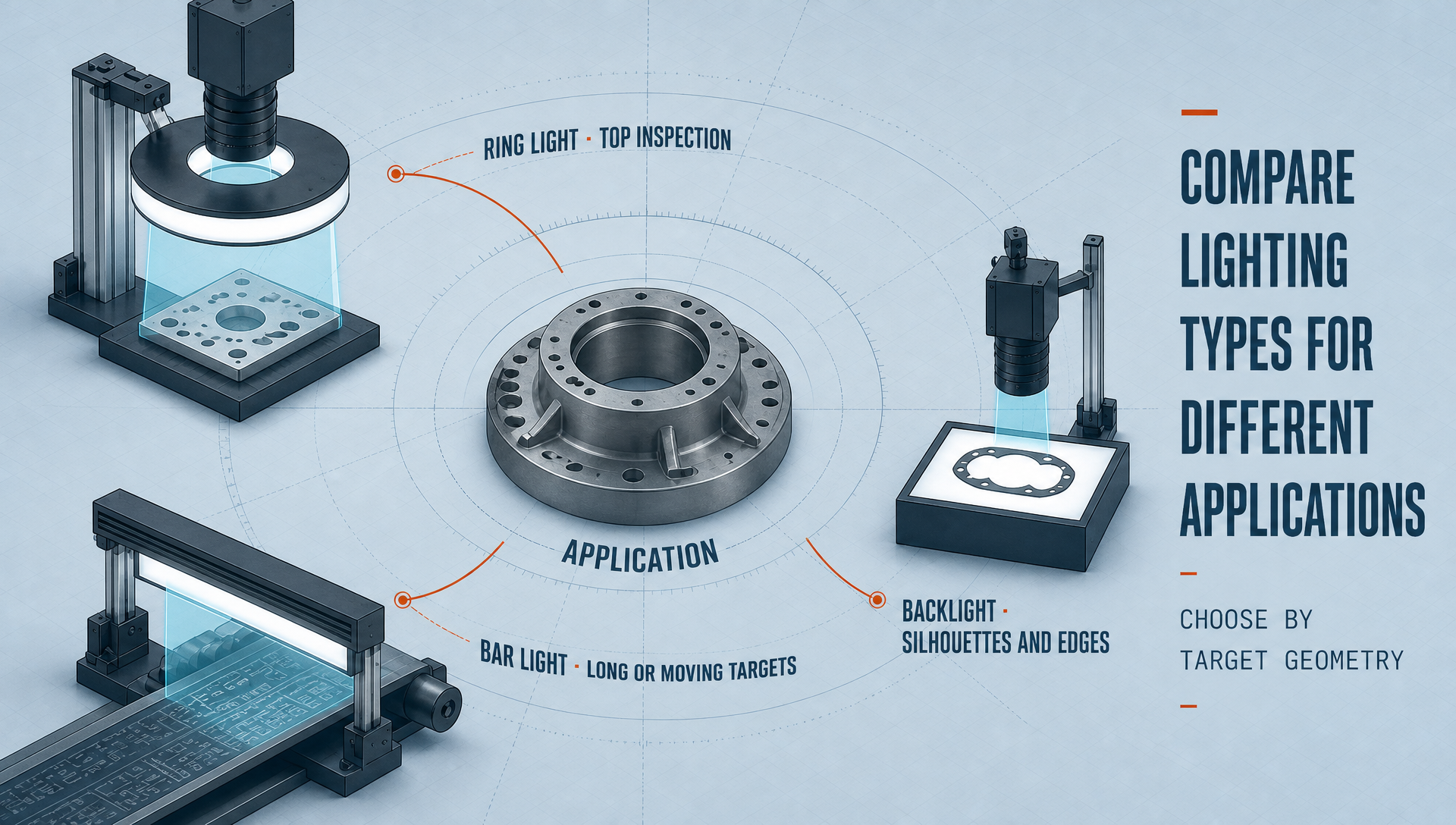
Compare Lighting Types for Different Applications
Ring Lights for General Inspection
Ring lights surround the optical axis to deliver direct lighting to the target. For wholesale machine vision lighting buyers, ring lights cover diverse tasks, including part verification, surface defect detection, and OCR reading.
HIFLY's machine vision light range includes ring, bar, backlight, coaxial, dome, and spot lights. Offering multiple configurations simplifies matching applications across volume orders.
Bar and Line Scan Lighting
When targets are long, wide, or moving fast, standard ring lights fail. Bar lights provide flexible directional illumination. Line scan systems demand high-intensity, uniform light for line-by-line image capture at extreme speeds.
HIFLY's line scan series suits web inspection, metal defect checks, and packaging lines. A dedicated high-brightness line scan light is ideal for continuous conveyor inspection.
Back, Dome, and Coaxial Lighting
Backlighting highlights silhouettes, holes, and edge profiles. Dome lights give shadowless coverage on shiny or curved surfaces, while coaxial lights eliminate glare on flat reflective targets.
Evaluate Specifications Beyond Brightness
Intensity and Uniformity
Required intensity depends on lens aperture, working distance, target material, and exposure speed. Excessive brightness causes blooming, while low output misses defects.
Spatial uniformity is critical. Uneven lighting alters software thresholds, causing false rejects. Evaluate peak intensity and distribution across the entire field of view.
Wavelength and Color Options
Materials react differently to light wavelengths. White light covers general tasks, but red, blue, infrared, or UV LEDs are often necessary to maximize feature contrast.
Sourcing multi-spectrum options is essential when supplying OEM lighting. HIFLY offers deep customization across LED colors, wavelengths, color temperatures, and enclosure sizes.
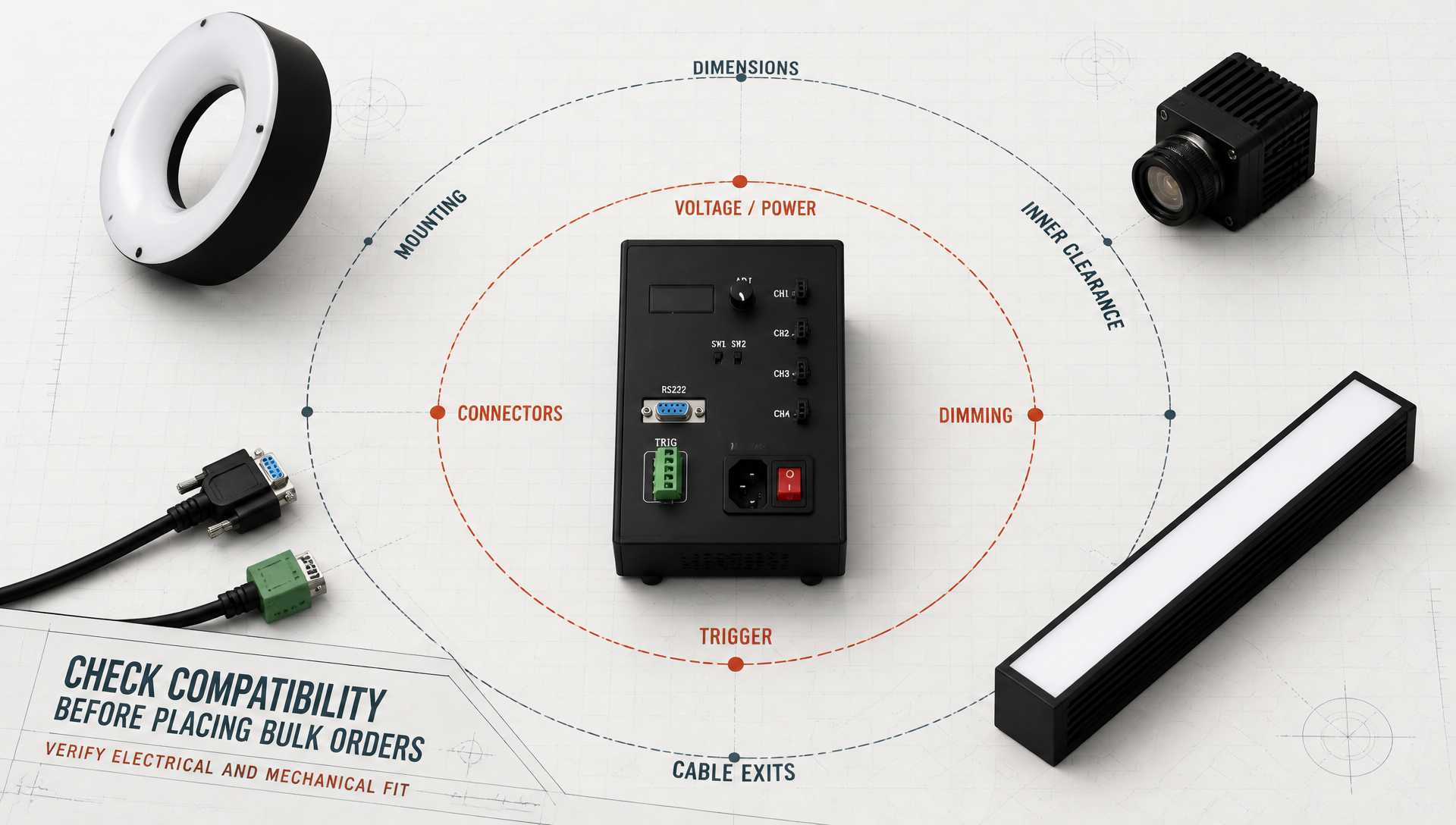
Check Compatibility Before Placing Bulk Orders
Electrical Compatibility
Verify voltage, power draw, pinouts, and dimming controls before ordering wholesale machine vision lighting. Confirm operating voltages, ensure controller wattage covers the load, match cable connectors, and test trigger compatibility with PLCs.
Mechanical Compatibility
Physical dimensions determine installation ease. Outer diameter, inner clearance, thickness, mounting holes, and cable exits must match machine constraints. Review mechanical drawings prior to finalizing bulk purchases.
Evaluate Supplier Capabilities for Wholesale Purchasing
MOQ and Production Capacity
Evaluate MOQ alongside scaling capacity. Low sample MOQs help prototyping, but suppliers must demonstrate reliable high-volume manufacturing and stable lead times for reorders.
Product Consistency
Consistency is vital for wholesale machine vision lighting. If brightness, color temperature, or dimensions drift between batches, integrators must re-calibrate vision software on every unit, driving up deployment costs.
Consider Customization and Private Label Requirements
Custom Size and Optical Parameters
Standard fixtures do not always fit custom machines. Unique angles, custom wavelengths, or specific housing footprints are often required for proprietary OEM lighting integrations.
HIFLY supports broad OEM customization across dimensions, LED spectrums, power outputs, and interfaces.
Branding and Packaging
Distributors and OEMs often need private labeling, laser-etched logos, custom packaging, and custom manuals. Establish these requirements early to avoid delays.
Calculate Total Purchasing Cost
Unit Price Is Not the Whole Cost
A low unit price does not equal low total cost. Factor in shipping, custom controllers, mounting hardware, cabling, tariffs, and potential warranty support.
Consider Long-Term Replacement
Ensure long-term product availability so replacement units can swap into existing systems without altering mechanical mounts or software settings.
Build a Wholesale Machine Vision Lighting Portfolio
Standardize Frequently Used Configurations
Stocking core configurations helps fulfill urgent client requests fast. A solid industrial portfolio includes general ring lights, directional bar lights, silhouette backlights, line scan bars, and diffuse dome fixtures.
Keep Application Information With the Product
Maintain detailed internal specs linking model numbers to working distances, coverage areas, optimal angles, matching controllers, and target materials.
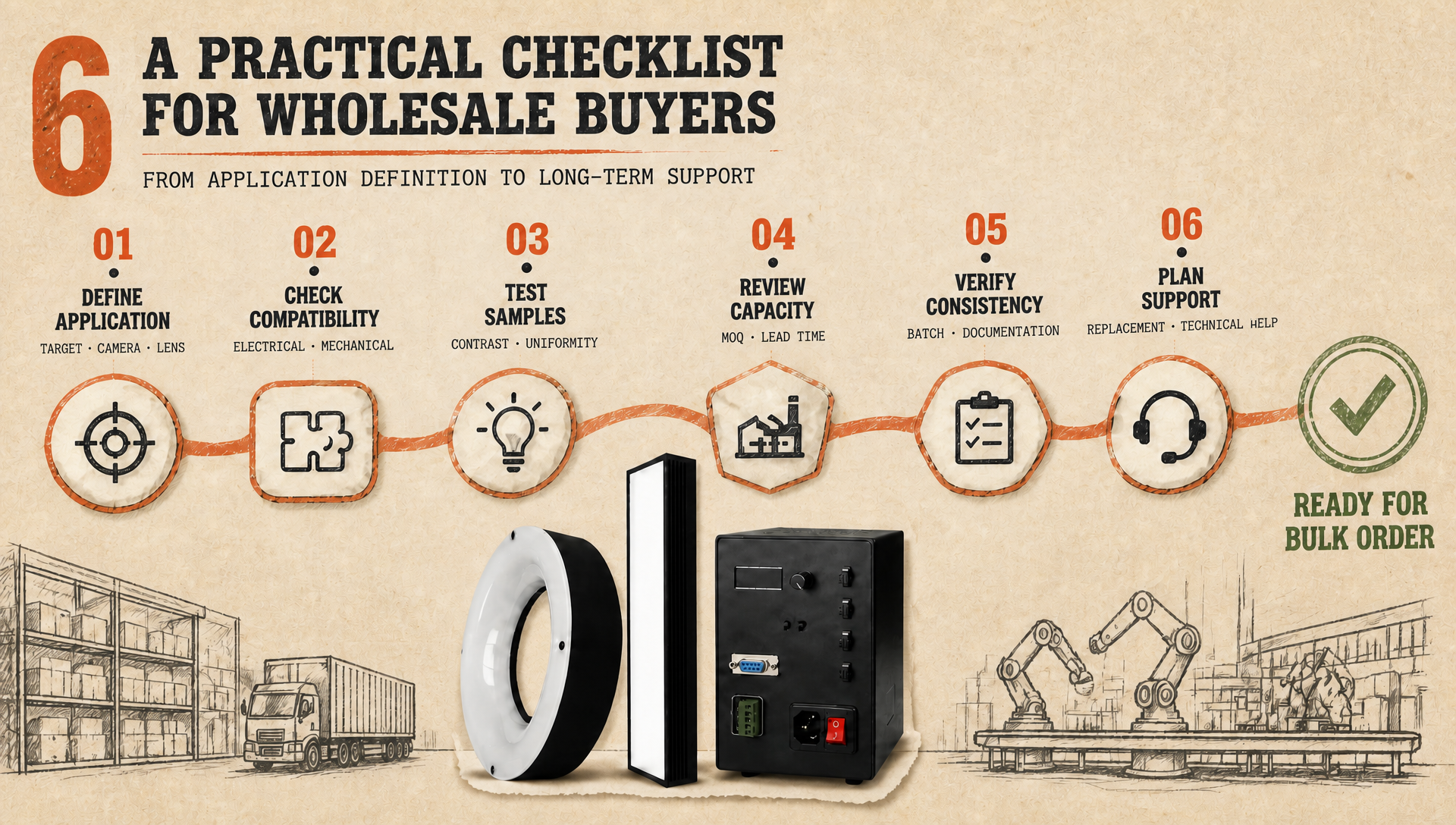
A Practical Checklist for Wholesale Buyers
Technical Checklist
Verify specs early: lighting geometry, voltage/power, dimensions, mounting interfaces, intensity, uniformity, wavelength, connectors, and working distance.
Supplier Checklist
Audit commercial fit: sample lead times, volume MOQs, production capacity, batch consistency controls, private labeling, and technical support.
Selecting the Right Machine Vision Light Supplier
Choose a supplier that balances technical performance with supply chain stability. The ideal machine vision light manufacturer delivers strong optical performance, batch consistency, complete documentation, and responsive OEM support.
HIFLY offers standard and custom industrial vision lighting engineered for demanding automated inspection applications.
FAQ
What should wholesale buyers check first?
Define target material, camera sensor type, working distance, field of view, and required lighting geometry.
Is the cheapest machine vision light best for bulk orders?
No. Total cost depends on optical uniformity, electrical compatibility, batch consistency, build quality, and supply stability.
Can machine vision lighting be customized for OEM projects?
Yes. Manufacturers like HIFLY offer custom sizing, LED wavelengths, emission angles, intensity levels, and connectors for OEM lighting projects.
Should buyers test samples before bulk orders?
Always. Benchtop testing verifies image contrast, uniformity, and integration before issuing large purchase orders.