EN
EN


SWIR Camera Guide: What It Is & Industrial Applications
For industrial OEMs, system integrators, and manufacturing stakeholders, the SWIR camera is a transformative imaging technology that unlocks non-destructive, material-specific inspection capabilities unavailable to visible-light or thermal systems. This comprehensive guide breaks down the core technology behind SWIR imaging, high-impact industrial use cases, and key operational advantages that make the SWIR camera indispensable for modern manufacturing, semiconductor, and outdoor automation applications.
How SWIR Cameras Work: InGaAs Sensors and the 0.9–2.5 µm Spectrum
Why the SWIR Band (0.9–2.5 µm) Enables Unique Material Interactions
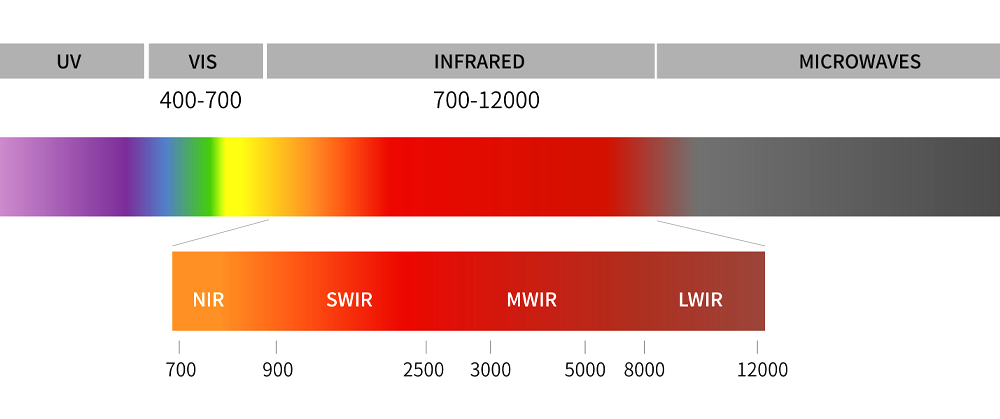
Short-wave infrared (SWIR) cameras operate in the 0.9–2.5 µm spectral band, where light interacts with materials in ways distinct from visible or thermal radiation. SWIR wavelengths penetrate silicon, thin plastics, and atmospheric haze while revealing molecular absorption features—enabling functional imaging beyond surface appearance. For instance, water vapor strongly absorbs at 1.4 µm, allowing precise moisture mapping in grains, pharmaceuticals, and produce. Organic compounds—including oils, sugars, and polymers—exhibit characteristic absorption bands across this range, supporting non-contact compositional analysis. These properties let SWIR cameras visualize subsurface structures and chemical variations that remain invisible to visible-light or uncooled thermal systems.
InGaAs Photodiode Arrays: The Core Enabling Technology for SWIR Cameras
Indium Gallium Arsenide (InGaAs) photodiode arrays are the dominant sensor technology for SWIR imaging. This semiconductor delivers high quantum efficiency (70–80%) across 0.9–1.7 µm, with extended variants now covering up to 2.5 µm. Its low dark current (<100 pA/cm² at 300K) supports strong signal-to-noise performance even under low-light conditions. Crucially, InGaAs sensors operate effectively at thermoelectrically cooled or near-room temperatures—unlike mercury cadmium telluride (MCT) or quantum-well infrared photodetectors (QWIPs), which require cryogenic cooling. This eliminates bulky, power-intensive refrigeration systems, reducing overall system complexity and power consumption by over 60% compared to cooled MWIR alternatives (Future Markets 2023). That balance of sensitivity, spectral coverage, and operational practicality makes InGaAs the foundational technology for industrial SWIR cameras.
Top Industrial Applications of SWIR Cameras
Semiconductor Wafer Inspection: Detecting Subsurface Defects with SWIR Cameras
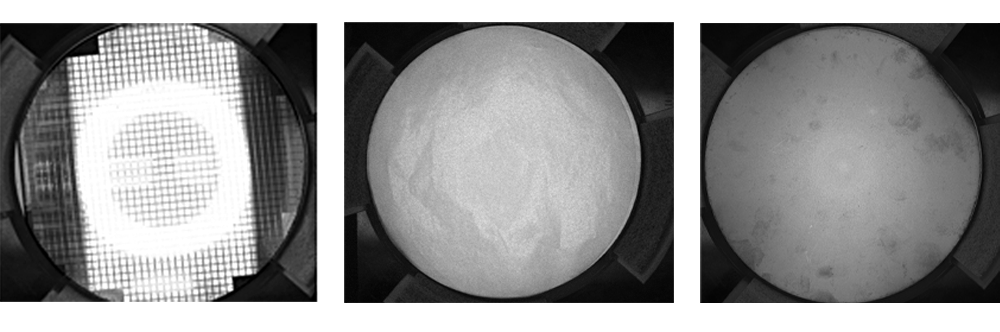
Silicon is highly transparent in the SWIR band—particularly between 1.1 and 1.7 µm—allowing SWIR cameras to image subsurface features non-destructively. This enables real-time detection of micro-cracks, dopant variations, voids, and particulate contamination beneath the wafer surface. Unlike visible-light inspection, which only reveals surface-level anomalies, SWIR imaging identifies defects that could compromise device functionality before final packaging. Leading fabs report a 40% reduction in field returns after integrating SWIR-based inline inspection, underscoring its role in improving yield and reliability without adding process steps or destructive testing.
Moisture and Composition Analysis in Food and Agriculture Using SWIR Cameras
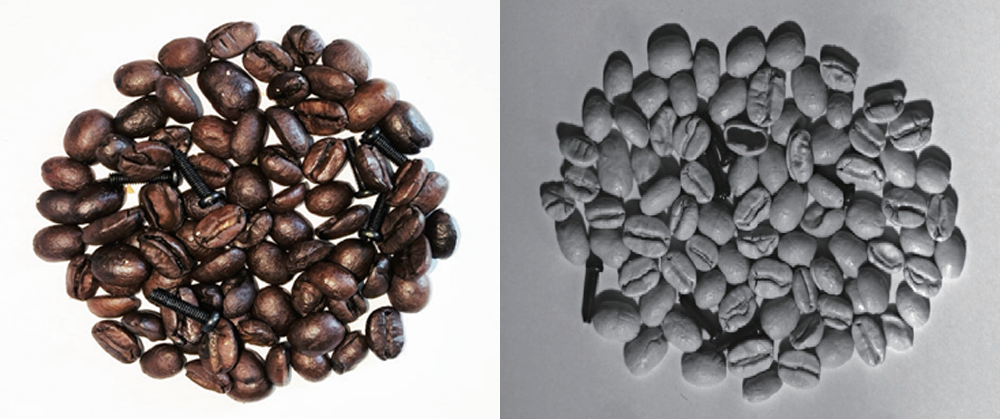
SWIR spectroscopy enables rapid, non-contact quantification of key constituents—including water, lipids, proteins, and carbohydrates—based on their unique absorption signatures. Because many food-grade plastics and packaging films transmit SWIR radiation, measurements can be made through sealed containers, eliminating sampling delays and contamination risks. Applications include:
- Real-time moisture monitoring in cereal grains, coffee beans, and dairy powders
- Sugar content estimation in apples and citrus during sorting
- Detection of plastic fragments or stones in harvested produce
Industry deployments show SWIR-based inspection increases throughput by 70% versus traditional lab sampling, with immediate feedback loops that reduce waste and support compliance with food safety standards.
Key Operational Advantages of SWIR Cameras for Industry
See-Through Imaging: SWIR Penetration of Silicon, Plastics, and Thin Packaging
The SWIR band’s material-transparency characteristics unlock robust “see-through” capabilities critical for quality assurance. Silicon wafers become translucent above ~1.1 µm, enabling defect detection below the surface layer. Likewise, common polymer packaging—such as polyethylene, polypropylene, and PET—transmits SWIR light while remaining opaque to visible cameras. This allows inspectors to assess fill levels, detect foreign objects, or verify moisture content inside sealed blister packs, pouches, or bottles—without opening or damaging the product. As a result, SWIR imaging converts traditionally destructive or offline verification steps into high-speed, non-invasive inline processes that preserve integrity and accelerate production.

All-Weather Performance: SWIR Cameras vs. Thermal and Visible Systems in Low-Light or Hazy Conditions
SWIR cameras combine the resolution advantages of visible imaging with the environmental resilience of longer-wavelength systems. Their 1.4–2.5 µm operation minimizes Rayleigh scattering from fog, dust, smoke, and light rain—maintaining contrast and detail where visible-light cameras degrade rapidly. Unlike thermal (LWIR/MWIR) systems, which rely on emitted heat and suffer in low-contrast scenes—such as identifying camouflaged objects against ambient backgrounds—SWIR captures reflected sunlight or active illumination, delivering high-resolution imagery independent of target temperature. This makes SWIR uniquely suited for 24/7 operations: it functions effectively at dawn/dusk without artificial lighting, avoids solar glare issues common in daytime thermal imaging, and provides consistent image quality across diverse lighting and weather conditions—critical for autonomous vehicles, maritime navigation, and perimeter surveillance.

Ready to Unlock Advanced Imaging Capabilities with a High-Performance SWIR Camera?
The SWIR camera is a game-changing technology that enables non-destructive, material-specific inspection and all-weather imaging—capabilities no visible-light or thermal system can replicate. By integrating a SWIR camera into your industrial workflow, you’ll reduce product waste, improve yield, ensure regulatory compliance, and unlock new quality control possibilities for your manufacturing or automation operation.
For industrial-grade SWIR camera solutions tailored to your semiconductor, food & agriculture, or outdoor automation application, or to build a fully integrated imaging system with complementary lenses, lighting, and AI analytics tools (as offered by HIFLY), partner with a provider rooted in industrial machine vision expertise. HIFLY’s 15 years of experience spans SWIR camera design, OEM custom manufacturing, and end-to-end vision system integration—backed by ISO 9001:2015 certification, global regulatory compliance support, and dedicated engineering services. Contact us today for a no-obligation consultation, custom sample testing, or to design a SWIR camera solution optimized for your specific application.